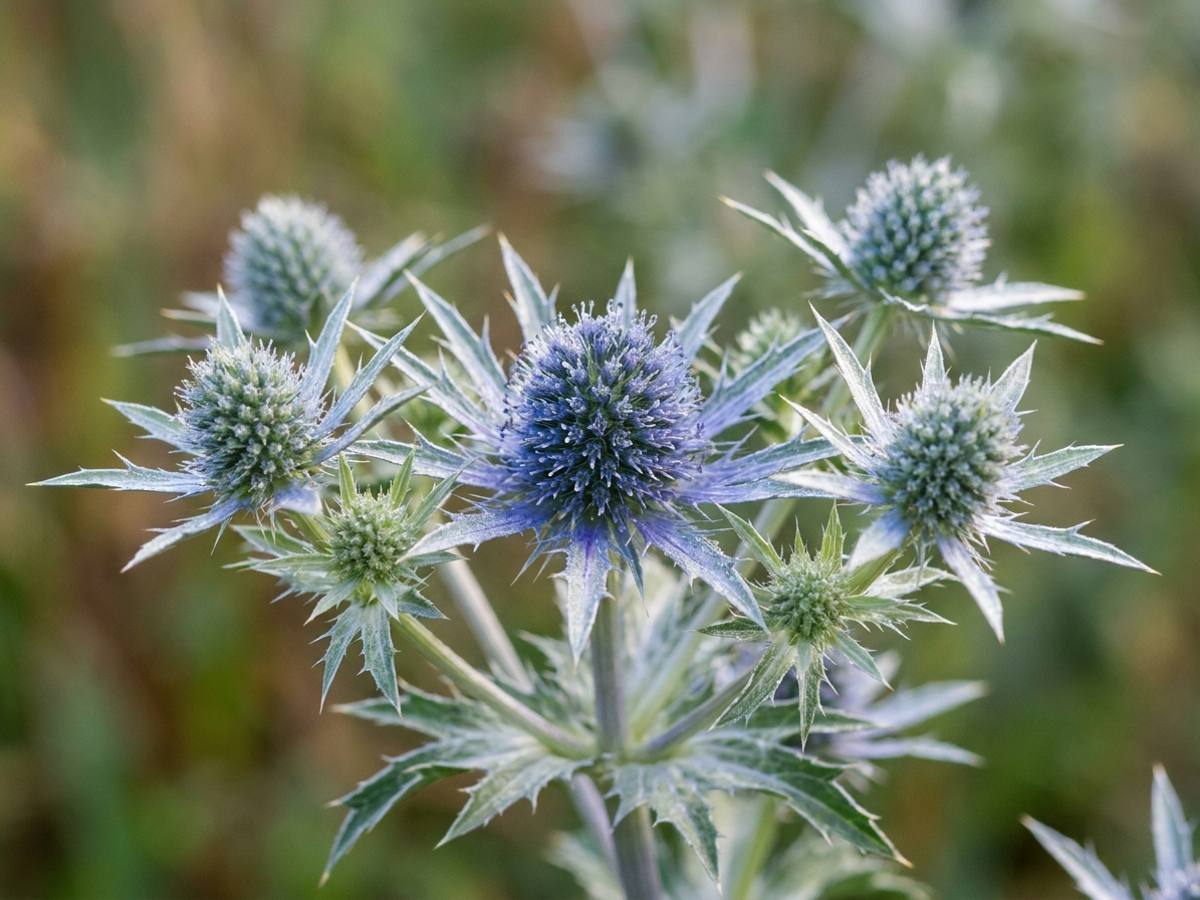
Eryngium giganteum is the great silver thistle of the summer border, sending up branching stems topped with domed cones surrounded by broad, spiny, ice-white bracts. Famously nicknamed Miss Willmott’s Ghost after the Edwardian plantswoman who is said to have scattered its seed in other people’s gardens, it brings architecture and metallic sparkle to gravel gardens and prairie planting. Its most distinctive trait is that it is monocarpic — each plant flowers spectacularly once, sets seed, then dies, leaving its offspring behind.
Give Eryngium giganteum the sunniest, most open spot you have. Full sun for at least six hours a day produces the strongest stems and the brightest silver bracts. In shade or crowded among taller neighbours it becomes green, lax and disappointing.
Drainage matters more than fertility. This is a taprooted plant from the dry hillsides of the Caucasus and Iran, so it thrives in sandy, stony or chalky ground and tolerates a pH from neutral to strongly alkaline. Heavy, wet clay is the one soil it truly resents — improve it with grit and coarse sand, or grow the plant on a raised bank.
Cold is rarely a problem: mature rosettes shrug off −20 °C provided the crown is dry. It is superb in coastal gardens, standing up to salt-laden wind, and is an excellent choice for water-wise Mediterranean-style planting.
Plant young, pot-grown specimens in spring so they have a full season to build a taproot before flowering the following summer. Autumn planting is possible on light soil, but avoid it where winters are wet.
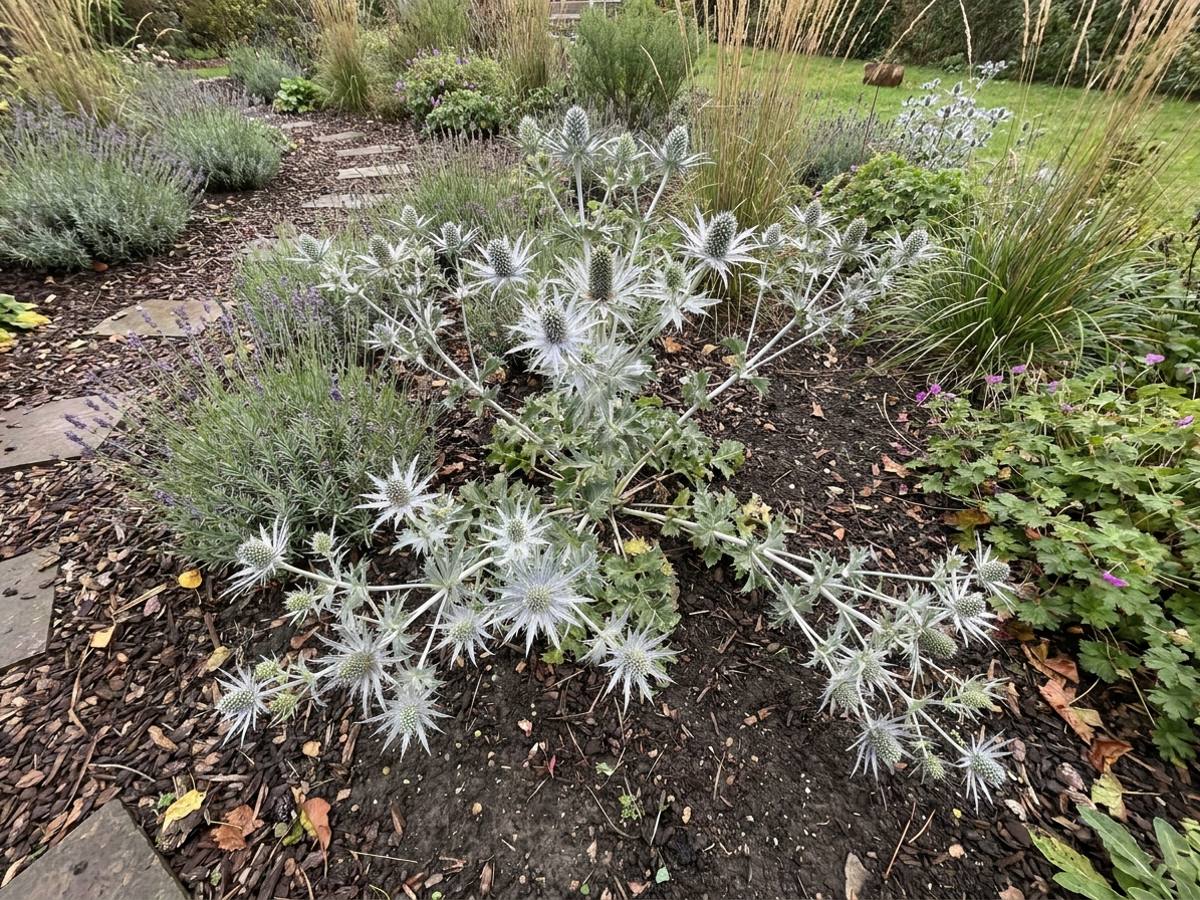
Sea holly asks for very little, but what it asks changes with the season. This table sets out what the plant is doing and what, if anything, you need to do about it.
| Season | What the plant does | What to do |
|---|---|---|
| Early to late spring | Overwintered rosettes expand fast, then send up flowering stems | Clear soggy leaf litter from the crown, hand-weed rather than hoe, and do not feed |
| Midsummer to late summer | Flowers open and the bracts turn from soft green to pewter-white | No watering needed; cut stems for drying in late summer if you want to limit self-seeding |
| Early to late autumn | Seed ripens and drops, and the first seedlings germinate | Leave a few seedheads standing, move seedlings while tiny, top-dress with gravel not wet mulch |
| Early winter to midwinter | Flowered plants die away; young rosettes stay green | Nothing beyond making sure drainage at the neck stays sharp |
In short, the only real intervention is deciding how much seed you allow the plant to shed.
Spring: Overwintered rosettes expand rapidly from March, throwing up flowering stems by late May. Clear away any soggy leaf litter around the crown and hand-weed carefully rather than hoeing near the taproot. No feeding is needed; a rich diet only produces weak, leaning stems.
Summer: Flowering begins in July, the bracts turning from soft green to luminous pewter-white. Established plants need no watering at all in most British summers. If you want to control self-seeding, cut the stems for drying in late August before the seed ripens and drops.
Autumn: Leave a few seedheads standing — they are handsome in frost and guarantee next year’s plants. Seedlings germinate in autumn or the following spring and can be nudged into position while very small. Do not mulch over the crowns with wet organic matter; a top-dressing of gravel is far safer.
Winter: Flowered plants die away completely, while young rosettes sit tight and green through the cold. No protection is required beyond sharp drainage at the neck.
Named forms of the species are few, so it is worth knowing the closest relatives too.