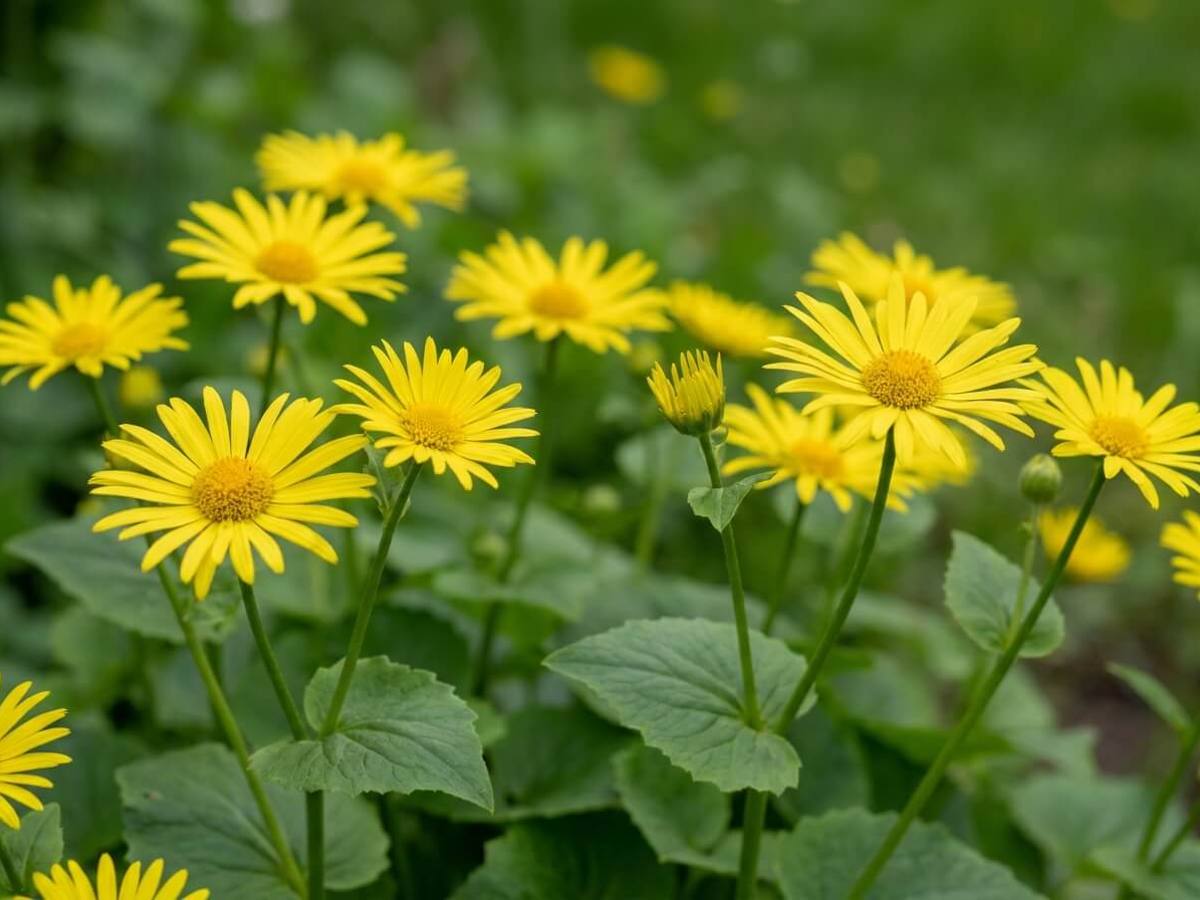
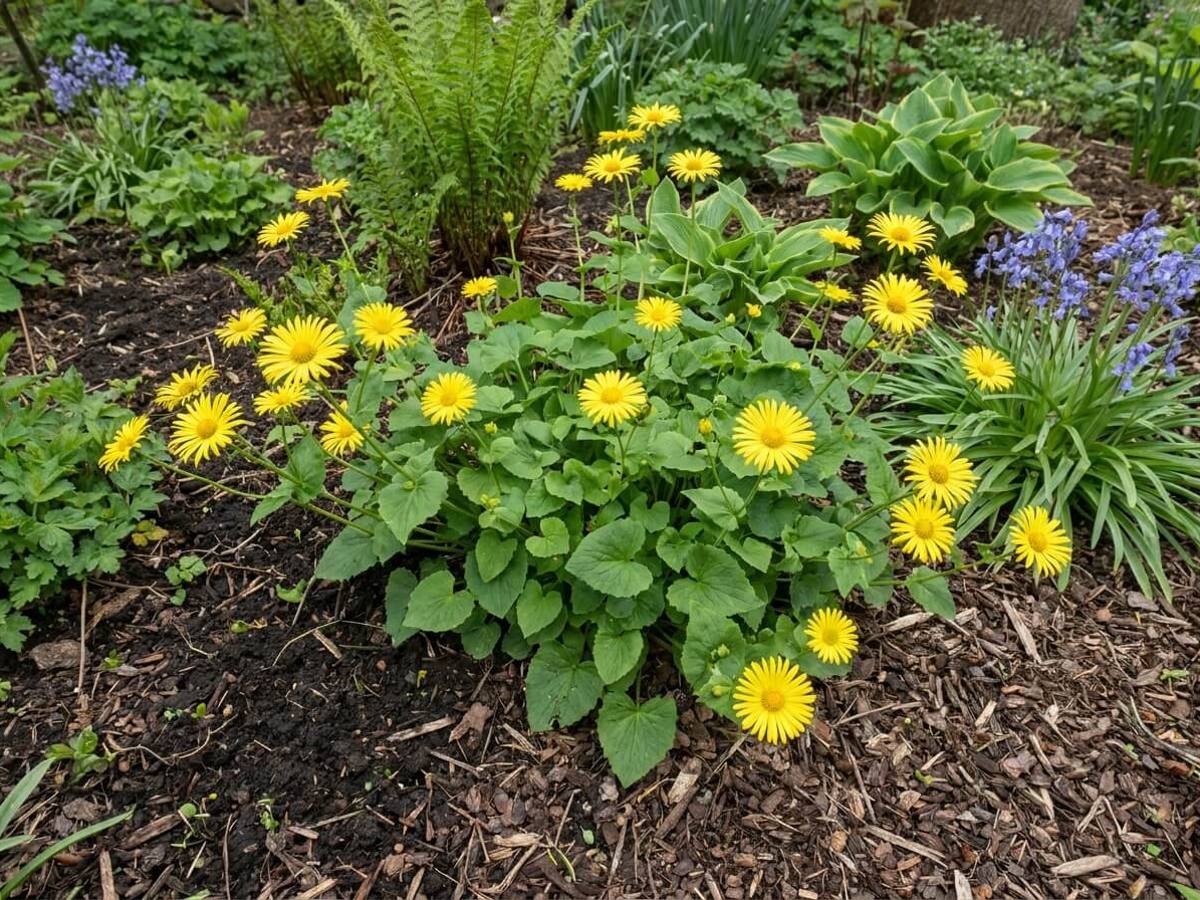
Few perennials mark the turn of spring as cheerfully as Doronicum orientale, whose golden daisy flowers open above fresh heart-shaped leaves while most borders are still waking up. It is one of the very earliest yellow daisies of the year, flowering alongside tulips, forget-me-nots and blue muscari for a classic spring picture. Its quirk is a habit of retreating into summer dormancy once the heat arrives, so it needs thoughtful placement among later-rising neighbours.
Growing conditions
Leopard’s bane flowers best with a good few hours of spring sunshine, which is easily achieved beneath deciduous trees and shrubs before the canopy closes. It also copes well with partial shade, and in warmer regions light afternoon shade actually extends the flowering season. Avoid deep, dry shade under conifers, where flowering becomes sparse and the foliage stays thin.
The ideal soil is moisture-retentive but free-draining, enriched with leaf mould or garden compost. It grows happily on heavy clay provided winter water does not sit around the crown, and it is untroubled by chalk or a neutral to slightly alkaline pH. Very sandy, quick-draining ground is the least suitable, since it triggers early summer dormancy.
Cold is no obstacle: this is a Caucasian and south-eastern European species that shrugs off hard frost. Hot, humid summers are the greater challenge, so gardeners in warmer zones should treat it as a spring performer and expect the foliage to disappear by midsummer.
How to plant Doronicum
Autumn is the best planting time, giving the shallow root system a full cool season to settle before it flowers. Container-grown plants bought in bud can also go in during early spring, though they will need attentive watering in their first summer.
Spacing: Set plants 30–40 cm apart so the leafy rosettes knit into a continuous carpet without trapping stagnant air, which encourages mildew.
Depth: Plant so the crown sits level with the soil surface — burying it invites rot, while planting too high exposes the fleshy rhizomes.
Soil preparation: Fork a bucketful of well-rotted compost or leaf mould into each planting area, and add grit to heavy clay to lift drainage.
Watering in: Soak thoroughly after planting, then keep the soil evenly damp for the first six weeks; the roots are shallow and dry out fast.
Propagation: Lift and divide congested clumps every three to four years in early autumn, or immediately after flowering, replanting vigorous outer sections.
Doronicum orientale growing in a naturalistic garden border
Care through the seasons
Spring: Growth appears remarkably early, so clear away any smothering mulch or fallen leaves as soon as the rosettes emerge. A light scattering of balanced general fertiliser or a top-dressing of compost supports the flush of flower. Deadhead spent blooms regularly to encourage a longer display and to prevent self-seeding.
Summer: Once flowering finishes, foliage often yellows and dies back in warm, dry weather — this is natural summer dormancy, not disease. Watering during dry spells keeps the leaves green for longer, though many gardeners simply cut the plant back and let neighbouring perennials fill the gap. Hardy geraniums, hostas, astrantias and day lilies are ideal companions for masking the bare patch.
Autumn: Cut back any remaining tired foliage and tidy the crown. Early autumn is the prime moment to divide clumps, since the plant resumes root growth in cool, moist conditions. Finish with a mulch of leaf mould around, rather than over, the crowns to feed the surface roots.
Winter: The plant is completely dormant and needs no protection whatsoever in temperate gardens. Simply ensure it is not sitting in waterlogged soil, which is the one real winter risk.
Best varieties to grow
A handful of selections cover every use, from tight edging to bold border clumps.
‘Little Leo’ — a compact, free-flowering form at just 25–30 cm, with semi-double golden blooms; excellent for edging and troughs.
‘Magnificum’ — the traditional garden form, reaching 45–50 cm with large single daisies, superb for cutting and naturalising.
‘Frühlingspracht’ (also sold as ‘Spring Beauty’) — double, shaggy yellow flowers on 40 cm stems, longer lasting than the singles.
‘Finesse’ — narrow-petalled, refined flowers on slender stems, giving a lighter, more airy effect in mixed planting.
Pests, diseases and common problems
Powdery mildew: A white bloom on the leaves in warm, dry weather, especially on crowded plants. Improve air circulation by dividing clumps, water the soil rather than the foliage, and remove affected leaves promptly.
Slugs and snails: They shred the soft young rosettes and flower buds in early spring. Clear hiding places near the crowns, hand-pick after dusk in mild damp weather, and protect emerging shoots with wool pellets or crushed grit.
Leaf miners and leaf spot: Pale winding tunnels or brown blotches on the foliage, usually cosmetic rather than serious. Pick off and bin marked leaves, and avoid overhead watering late in the day.
Crown rot in wet soil: Collapsing, blackened crowns after a soggy winter. Lift and replant divisions on a gritty ridge or raised bed to keep the rhizomes above standing water.