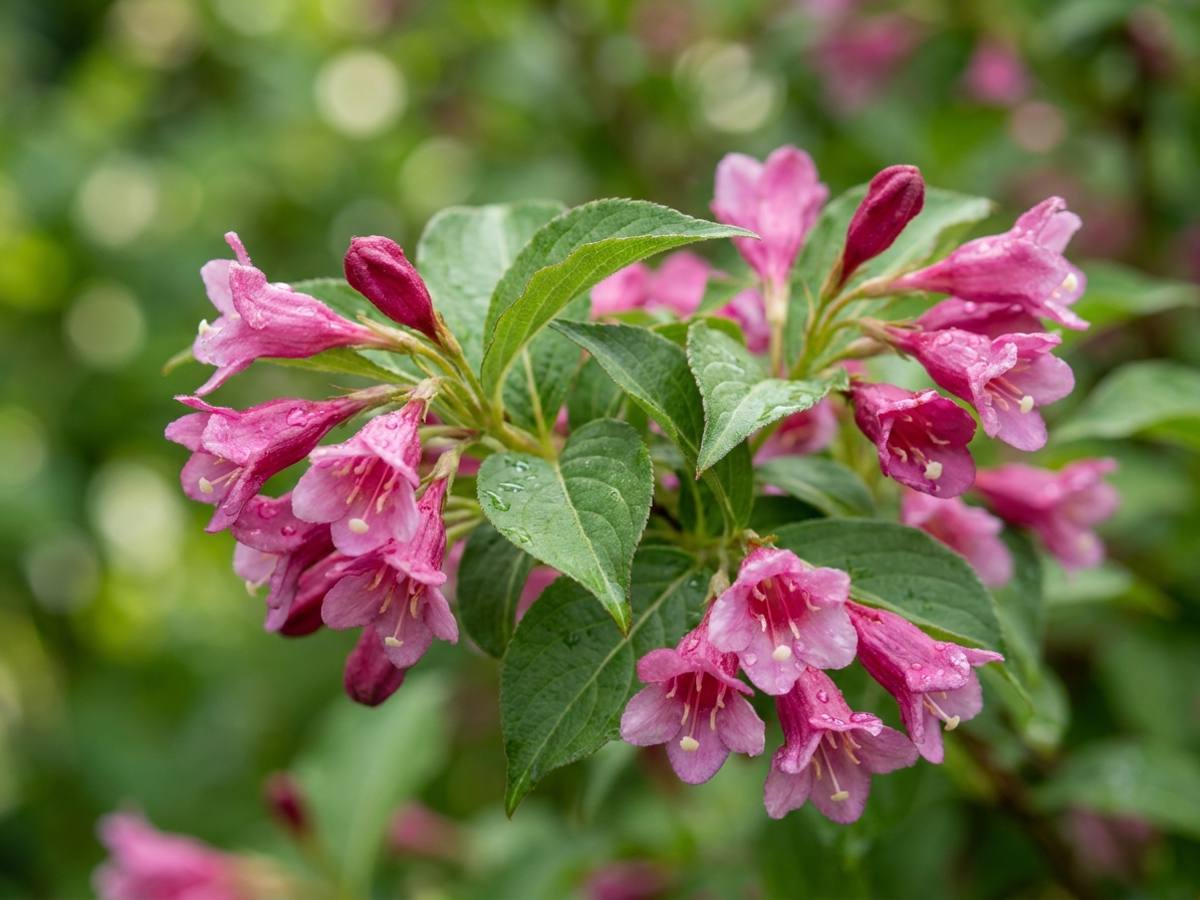
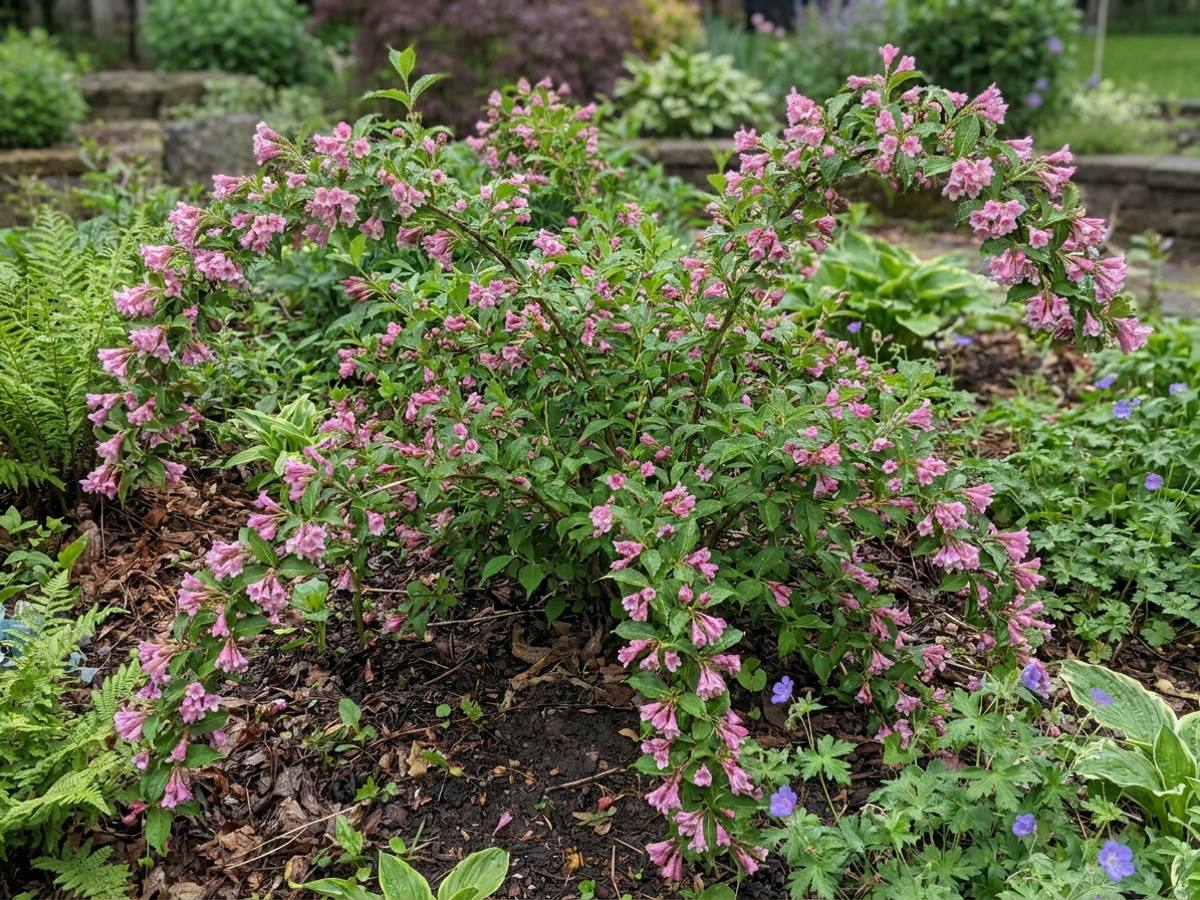
Weigela florida is a dependable deciduous shrub that smothers itself in trumpet-shaped pink or rose flowers from late spring, when many borders are still finding their feet. It earns its place as a low-maintenance backbone shrub for mixed borders, informal hedges and cottage-garden schemes, and the flowers are irresistible to bees and hummingbird hawk-moths. Many modern cultivars add a second string to their bow with dark purple, gold or variegated foliage that carries interest right through to autumn.
Weigela flowers most generously in full sun, where the wood ripens properly and buds form along the whole length of each stem. It will cope with light or dappled shade, but expect fewer blooms and a looser, leggier habit. Purple-leaved and golden cultivars in particular need good light to hold their colour — in shade they simply revert to muddy green.
Almost any reasonable garden soil suits it, from heavy clay to chalk, provided it does not sit waterlogged in winter. The ideal is a fertile, moisture-retentive loam enriched with organic matter, with a pH anywhere between mildly acid and mildly alkaline (roughly 6.0–7.5). Improve compacted or sticky ground with garden compost and coarse grit before planting.
Hardy to around −20 °C, weigela is unfazed by British and northern European winters and thrives across USDA zones 4–8. In hot, dry Mediterranean-type climates it appreciates afternoon shade and a thicker mulch to keep the roots cool.
Autumn is the ideal planting season, giving roots months of moist, warm soil to establish before flowering. Spring planting works equally well, provided you commit to regular watering through the first summer.
Almost everything that decides whether a weigela flowers well comes down to doing the right job at the right moment. This table sets out the four seasonal tasks and, crucially, the only window in which pruning is safe.
| Season | Main job | Pruning | Feeding & watering |
|---|---|---|---|
| Early to mid-spring | Feed and top up the mulch as buds break | Snip frost-damaged or dead tips back to healthy wood only | Balanced general fertiliser or blood, fish and bone |
| Early summer, as the main flush fades | The one pruning window of the year | Flowered stems back by a third; one in three of the oldest stems to ground level | Water deeply once a week in prolonged drought |
| Autumn | Best moment to plant, move or replace | None — it removes next year’s flowers | Fresh mulch of compost over the roots |
| Midwinter | Leave the shrub dormant and undisturbed | None | No protection needed; fleece or hessian for pots in exposed spots |
Keep to this rhythm and the shrub looks after itself; prune outside the early-summer window and you simply cut off the coming display.
Spring: Scatter a balanced general fertiliser or blood, fish and bone around the base as buds break, then top up the mulch. Check for any frost-damaged or dead tips and snip them back to healthy wood. Resist the urge to prune hard now — the flower buds are already sitting on last year’s stems.
Summer: Prune immediately after the main flush of flowers fades, usually late June, cutting back the stems that have bloomed by about one third. At the same time, remove one in three of the oldest, woodiest stems at ground level to keep the shrub youthful. Water deeply once a week in prolonged drought, especially for plants under two years old or in pots.
Autumn: This is the best moment to plant, move or replace weigela while the soil is still warm. Leave the framework of stems intact — autumn pruning removes next year’s flowers and can encourage vulnerable soft growth. A fresh mulch of compost in November feeds the roots and protects them over winter.
Winter: The shrub is fully dormant and leafless, needing no protection in most gardens. Container-grown specimens benefit from being moved against a wall and wrapped with fleece or hessian in very cold, exposed spots.
Choose according to the foliage colour and final size you need, as cultivars vary enormously.