Feather Reed Grass: varieties, planting and garden uses
Few ornamental grasses give as much structure for so little effort as Calamagrostis × acutiflora, the feather reed grass. Its narrow, strictly vertical flower stems rise to around 1.5 m in early summer, turning from a flushed pinkish-bronze to warm buff, and they stay standing through wind, rain and frost. It is one of the earliest grasses into growth each spring and one of the last to collapse in winter, making it an exceptionally long-serving plant in a border.
Growing conditions
Full sun gives the strongest, most upright stems and the best flowering. In partial shade the plant survives happily but produces fewer flowering culms and may lean towards the light, so allow at least six hours of direct sun where possible.
It is remarkably unfussy about soil, coping with heavy clay far better than most ornamental grasses, as well as loam, chalk and improved sand. A pH anywhere from mildly acidic to alkaline suits it. The one condition it dislikes is permanently waterlogged ground in winter, which rots the crown.
As a cool-season grass it performs best in temperate climates with cool springs and moderate summers, which is why it excels across northern Europe, the UK and the northern United States. In hot, humid summer regions growth can stall in July and August, and rust becomes more likely.
How to plant Calamagrostis
Plant in spring, from March to May, so roots establish during the grass’s natural period of active growth. Early autumn planting also works in mild areas, provided the soil is still warm.
Spacing: set plants 60–75 cm apart for individual specimens, or 45 cm apart where you want a continuous screen or hedge-like block within two seasons.
Depth: plant so the crown sits level with the surrounding soil — burying it deeper encourages rot.
Soil preparation: fork over compacted or clay soil to a spade’s depth and work in garden compost; avoid rich manure, which produces soft, floppy stems.
Watering in: soak thoroughly after planting and keep the root zone moist for the first full growing season, especially from April to July.
Propagation: divide established clumps in spring with a sharp spade, ensuring each piece has several shoots and healthy roots — seed is not an option, as the hybrid is sterile.
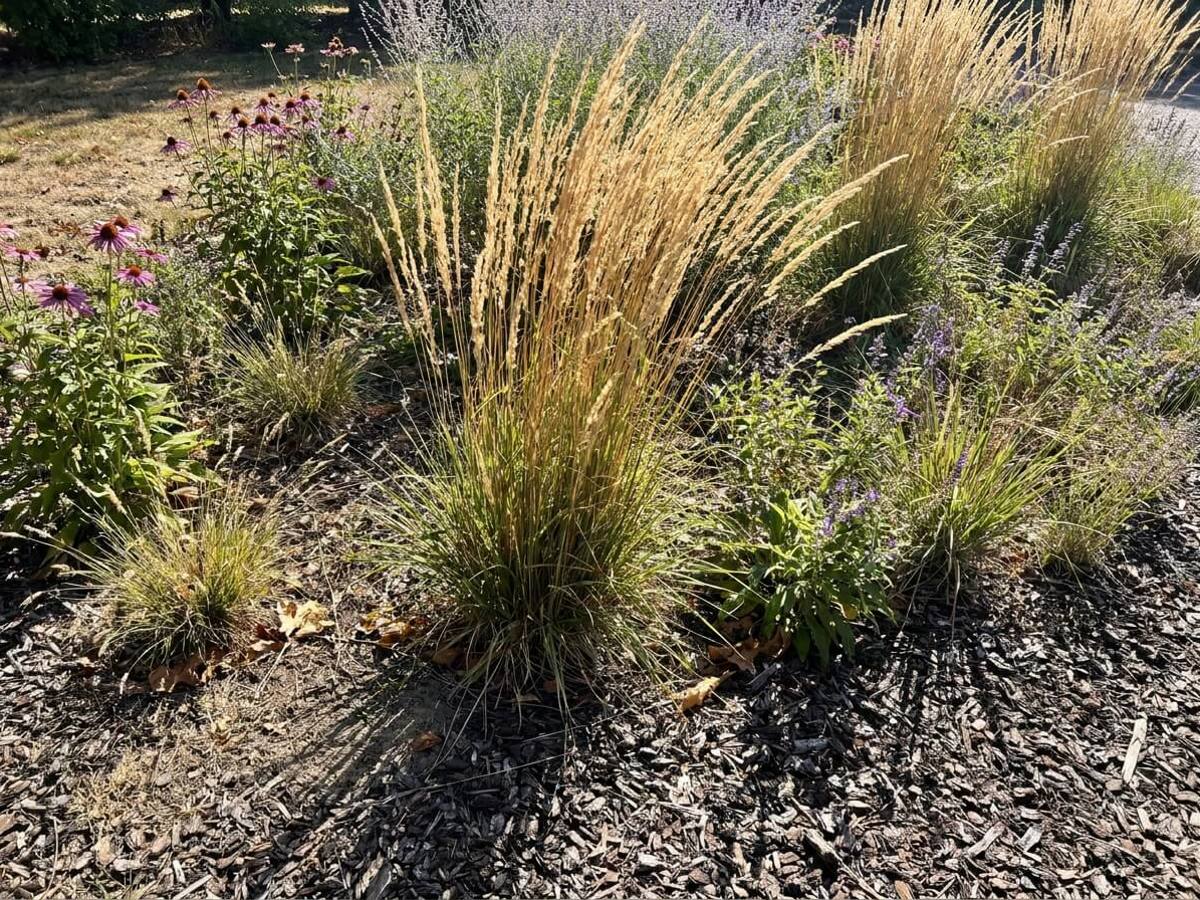
Calamagrostis acutiflora growing in a naturalistic garden border
Care through the seasons
Spring: Cut the previous year’s stems down to about 10 cm before new shoots emerge — this is usually needed by late February or early March, as feather reed grass starts into growth remarkably early. A light scattering of general-purpose fertiliser or a mulch of compost is ample; over-feeding causes flopping.
Summer: Flower spikes appear from June and are best left untouched, as they are the whole point of the plant. Water deeply during prolonged dry spells in the first two years; established clumps are reasonably drought-tolerant but may brown at the leaf tips. The clump expands slowly outwards and never runs, so no containment is needed.
Autumn: Resist the urge to cut back — the bleached stems are one of the finest winter features in any border. Autumn is a reasonable time to divide in mild regions, though spring division is safer on cold or wet soils. Mulch newly planted specimens with 5 cm of compost around, not over, the crown.
Winter: The foliage dies to straw-gold yet the stems remain upright through snow and frost, catching low winter sun. No protection is required in any temperate garden; container-grown plants simply benefit from being moved against a wall.
Best varieties to grow
All cultivars share the same upright habit, differing mainly in foliage colour and ultimate height.
‘Karl Foerster’ — the benchmark cultivar, holding an RHS Award of Garden Merit; green foliage, 1.5–1.8 m flowering stems and outstanding winter persistence.
‘Overdam’ — creamy-white variegated leaves with a pink flush on the young flowers, slightly shorter at around 1.2 m and happier with some afternoon shade.
‘Avalanche’ — a bright white central stripe down each leaf, giving a lighter, more luminous clump than ‘Overdam’.
‘Eldorado’ — golden-yellow variegation with green margins, reaching about 1.2 m and best in full sun to hold its colour.
Pests, diseases and common problems
Rust (Puccinia species): orange-brown pustules on the leaves in humid summers, worst on crowded plants. Improve air circulation by thinning neighbouring planting, remove affected leaves and cut the clump back hard in late winter to break the cycle.
Flopping or splaying stems: usually caused by too much shade, over-rich soil or excess nitrogen; move the plant into full sun, stop feeding and divide congested clumps that have gone hollow in the centre.
Crown rot: shoots fail to emerge in spring and the base is soft and brown, almost always a result of winter waterlogging. Lift and replant on a slight mound or improve drainage with grit before replanting.