A patio or balcony that gets a few hours of morning sun and then slips into shade for the rest of the day is a quiet place by September. The light is flat, the walls hold damp, and most summer bedding has gone over just as you start spending evenings out there again. A good autumn scheme for this spot leans on shrubs with substance, a few late flowerers that keep going until the first frosts, and at least one plant that is only just beginning when everything else is finishing.
Pot by pot, tallest first: Camellia, Hebe, Fuchsia, Beardtongue, Ornamental tobacco, Winter heather.
This is the backbone pot, the one that gives the group height and a solid wall of glossy dark evergreen leaves all year. Camellia thrives in exactly the dappled, sheltered light this corner offers, and autumn-flowering types open their blooms from late autumn onwards, just as the rest of the scheme fades. Stand it at the back or against the wall, where its dense foliage makes a dark backdrop that every pale flower in front of it reads against. It wants lime-free compost and its own pot — no companions crowding the roots.
Where the Camellia gives height, Hebe gives a rounded, tidy evergreen dome that holds its shape through winter when little else does. Many types carry spikes of mauve, pink or white flowers well into autumn, and the neat leaf pattern is interesting even bare. Place it just in front of and slightly to one side of the Camellia, so the two evergreens overlap and the group never looks empty. It takes partial shade well, though it will flower more freely at the sunnier end of the patio.
Few plants earn their place in shade as reliably as Fuchsia, which keeps producing its pendant flowers from summer right through to the first real cold. The dangling buds give the scheme movement and a vertical line that the rounded shrubs lack, and the colours — deep pink, violet, white — glow in low light where hot reds would simply disappear. Set it mid-group, at the edge of a bench or shelf if you have one, so the flowers hang clear and can be seen from below. It is the plant that carries the display through October.
Beardtongue sends up slim spires of tubular flowers over a long season, and if you keep removing the spent stems it will still be throwing up spikes when the nights turn cold. The upright flower stems break up the mass of domes and mounds behind them, and the narrow foliage keeps the planting light rather than heavy. It is happiest with a share of the morning sun, so give it the brightest spot in the group, immediately in front of the Hebe.
Ornamental tobacco is the scented element, and it is at its best in a part-shaded, enclosed spot where the evening perfume has nowhere to escape to. The flowers keep coming until frost finally stops them, and the soft green and white shades sit calmly beside the stronger pinks of the Fuchsia and Beardtongue. Treat it as a seasonal filler — it is the one plant here you will replace each year — and tuck it where you pass close by.
At the very front, low and spreading, Winter heather takes over the moment the frost-tender plants give up. Its fine needle-like foliage and dense little flower spikes in pink, mauve or white start in late autumn and carry on for months, covering the gap that most container schemes simply leave empty. Use it to soften the front edge and hide the bases of the taller pots behind.
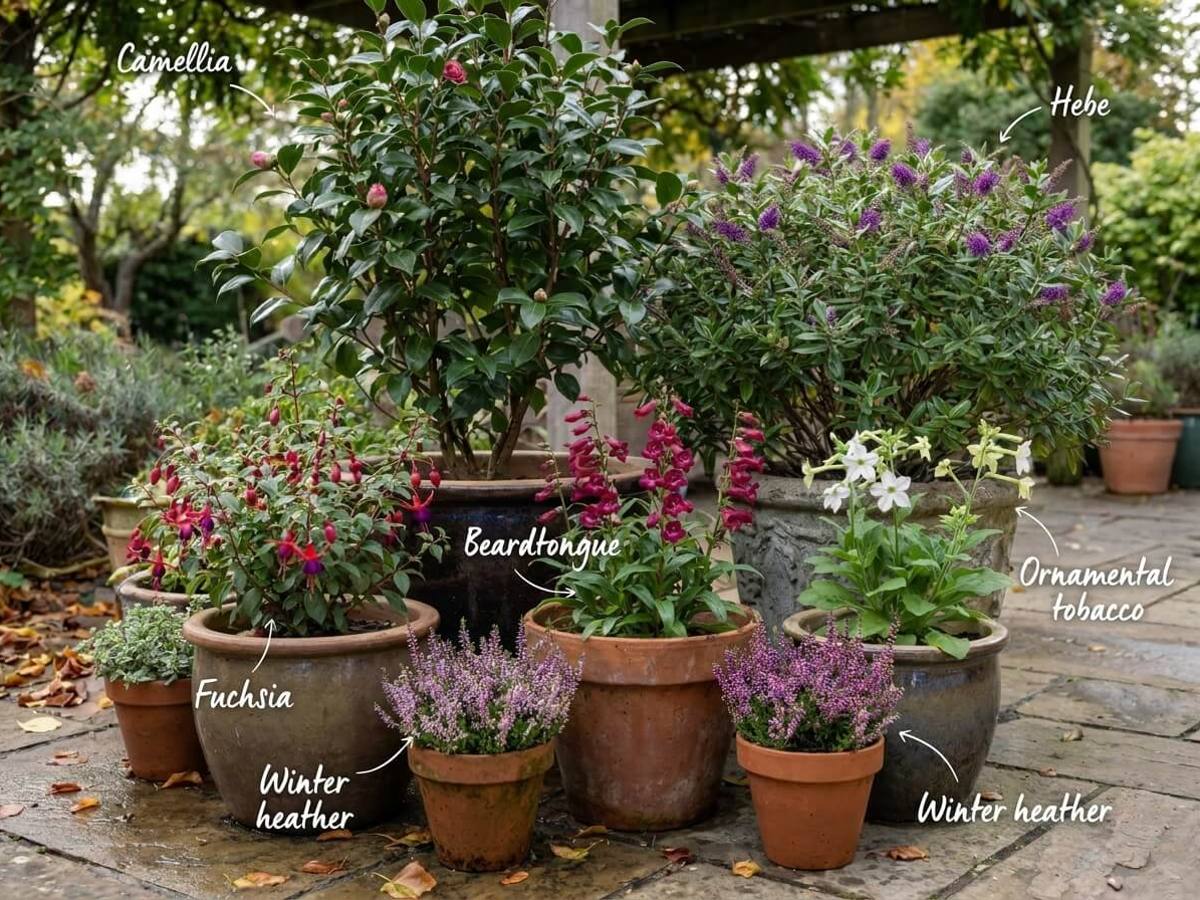
Give the Camellia a 50 cm pot of its own, filled with ericaceous compost, and stand it at the back against the wall. The Hebe takes a 40 cm pot a step forward and to one side; the Fuchsia a 30 cm pot, raised on a low stand or pot feet so the flowers hang free. The Beardtongue needs its own 30 cm pot in the brightest position, while the Ornamental tobacco and Winter heather can share a wide, shallow 35 cm trough at the front, or sit in separate 20–25 cm pots if you prefer to swap them out independently. In autumn, water the Camellia and Fuchsia roughly twice a week, the Ornamental tobacco every two or three days while it is still flowering, and the Hebe, Beardtongue and Winter heather about once a week — always check the top 3 cm of compost first, and cut everything back to once a week or less from November.
Through spring the group is mostly green: the Camellia and Hebe hold the structure, the Beardtongue pushes up fresh growth, and the Fuchsia breaks from its framework. Summer brings the Fuchsia and Beardtongue into full flower, with the Ornamental tobacco planted out in June to scent the evenings. Autumn is the peak — Fuchsia and Beardtongue still going, Hebe spiking, Ornamental tobacco at its most fragrant — and as those fade, the Winter heather opens and the Camellia follows. There is no truly blank moment, but if one comes it falls in late February, when two evergreen domes and a bare Fuchsia framework are all you have, and that is the week to top-dress the pots and cut back ready for spring.