A flat, open patch in full sun is one of the hardest places to keep interesting late in the year. The soil bakes and drains fast, there is nothing tall to cast shade or give structure, and most low-growing carpets have burnt themselves out by August. A good scheme layers plants that peak at different moments, so that the ground is covered all year and the colour arrives again just as everything else is winding down.
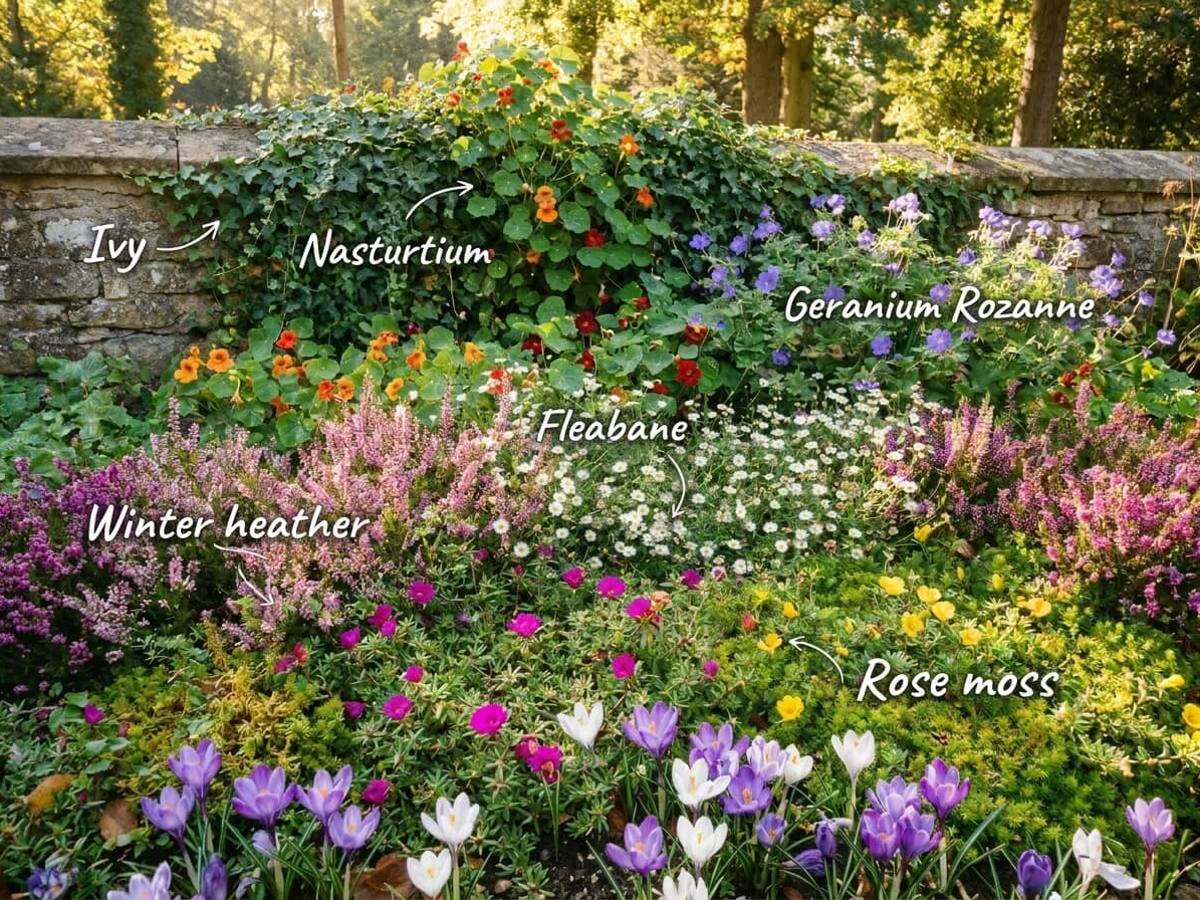
From back to front: Ivy, Nasturtium, Geranium Rozanne, Winter heather, Fleabane, Rose moss, Crocus.
Used flat rather than climbing, ivy gives the scheme its evergreen backbone along the back edge, where it can run over a wall base, a kerb or a dry bank. Mature growth produces its curious greenish flower heads in autumn, exactly when the rest of the planting is colouring up, and they are a magnet for late bees. Its dark, glossy leaves make the best possible backdrop for paler flowers in front, though you will need to shear the runners back once or twice a year so it does not swallow its neighbours.
Nasturtium is the quick filler of the group, sprawling into any gap and lifting the scheme with round, almost lily-pad leaves and hot orange, red and yellow flowers. Sown in spring, it keeps going right through to the first proper frost, so it carries the autumn display just as reliably as anything perennial. Keep it behind the smaller plants: it is generous to the point of bullying, and it will happily flop over anything delicate.
Geranium Rozanne is the one plant here that simply does not stop, throwing violet-blue saucers from early summer until the cold shuts it down in late autumn. The low, spreading mounds knit into the surrounding plants rather than sitting in isolated clumps, which is exactly what a carpet needs. Its cool blue is the perfect foil for the hot tones of the nasturtium, and the foliage takes on russet tints before it dies back.
Winter heather brings the structure that an all-herbaceous carpet lacks: tight evergreen hummocks of needle-fine foliage that hold their shape in every season. Its flower spikes open from late autumn onwards, so it picks up precisely where the frost-tender plants leave off. Plant it in drifts through the middle of the scheme, where the mounded texture breaks up the flatter, leafier growth on either side.
Fleabane covers ground with a haze of small daisies that open white and age to pink, giving two colours on the plant at once. It flowers for months and is still going strong in autumn, seeding itself gently into cracks, path edges and the spaces between the heather mounds. Treat it as the mortar of the scheme rather than a feature: it softens every hard edge it touches.
Rose moss thrives on exactly the conditions that defeat other ground cover, with succulent, cylindrical leaves that shrug off heat and drought in the most exposed part of the bed. The silky flowers in magenta, orange, cream and yellow open with the sun and keep coming until the weather turns properly cold. Put it right at the front where nothing will shade it, as it closes up and sulks in shadow.
Autumn-flowering forms of crocus push their goblets up through the carpet in September and October, apparently out of bare earth, with no leaves to announce them. They occupy no horizontal space at all, so they can be slipped in among every other plant in the scheme without competition. Scatter them generously, because their effect depends entirely on numbers.
Start at the back with ivy along the boundary, one plant every 60 cm or so, and be ready to cut its runners back to a line you choose. In front of it, space geranium Rozanne about 50 cm apart in a loose band, and sow nasturtium between them in spring so it threads through and tumbles forward. Through the middle, set winter heather in groups of three or five, roughly 40 cm apart, leaving a drift rather than a row. Fill the remaining gaps with fleabane at 30 cm, then keep the sunniest front edge for rose moss, sown or planted at 20 cm. Finally, plant crocus corms in late summer, 8 to 10 cm deep, in scattered groups of fifteen or twenty rather than evenly spread.
In spring, the scheme is mostly green: ivy and winter heather hold the shape while geranium Rozanne and fleabane push up new growth and the nasturtium seedlings get going. By midsummer it is a full carpet, blue and white with hot flashes of orange and the silky colours of rose moss at the front. Autumn is the high point, with crocus coming up through everything, fleabane and geranium Rozanne still flowering, nasturtium at its biggest and ivy humming with insects. Once frost clears the tender growth, you are left with glossy ivy and the flowering hummocks of winter heather, which is more than enough to carry a sunny patch through to spring.