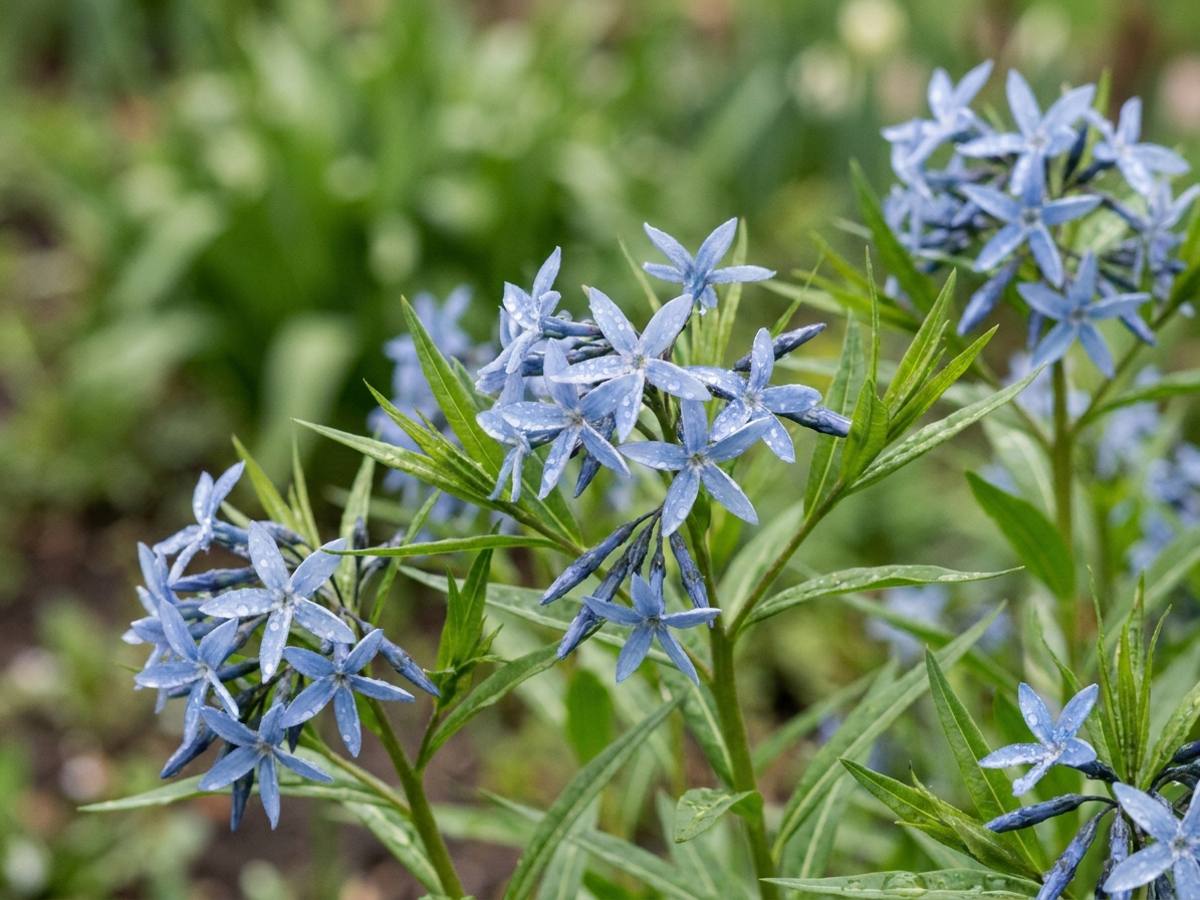
Eastern bluestar is one of those quietly dependable perennials that earns its place three times over: clouds of steely, star-shaped blue flowers in late spring, a tidy dome of willowy foliage all summer, and a blaze of butter-yellow leaves in autumn. It forms a shrubby, self-supporting clump that never needs staking and rarely needs dividing. Snap a stem and it bleeds milky white sap — a giveaway that it belongs to the dogbane family, and the reason deer and rabbits leave it well alone.
Growing conditions
Full sun gives the sturdiest, most upright plants and the best autumn colour. In hotter, drier regions — southern Europe or the American South — a few hours of afternoon shade prevents scorching and keeps the foliage fresh. In deep shade the stems stretch, flop outwards and the clump opens up in the middle.
Eastern bluestar is genuinely unfussy about soil, growing happily in heavy clay, ordinary loam or thin chalk, provided winter drainage is reasonable. It prefers evenly moist, fertile ground and will grow largest there, but established plants cope with periods of drought. A pH anywhere between mildly acidic and mildly alkaline (roughly 6.0–7.5) suits it well.
This is a tough North American prairie and woodland-edge native, hardy well below −25 °C and untroubled by wind or coastal exposure. Gardeners in mild, wet winter climates should simply avoid waterlogged hollows, where the crown may rot.
How to plant Amsonia
Plant in spring, once the soil has begun to warm, so the deep taproot-like root system establishes over a full growing season. Autumn planting works in milder areas, but spring is safer on cold or heavy ground.
Spacing: Allow 60–75 cm between plants — a mature clump becomes genuinely shrub-like and looks best with room to show its rounded outline.
Depth: Set the crown level with the surrounding soil; burying it deeper encourages rot and delays growth.
Soil preparation: Fork in a bucketful of garden compost or well-rotted manure per planting hole, especially on sandy or chalky soils that dry quickly.
Watering in: Soak thoroughly after planting and keep the soil damp for the first summer; new plants dislike drying out before their roots go down.
Propagation: Divide in early spring with a sharp spade, or take basal softwood cuttings in late spring — bluestar resents disturbance, so divide only when you really want more plants.
Amsonia tabernaemontana growing in a naturalistic garden border
Care through the seasons
Spring: Purple-tinged shoots push through in mid-spring and grow quickly into leafy stems topped with panicles of powder-blue stars. A light mulch of compost is all the feeding required; rich feeding or nitrogen-heavy fertiliser produces soft, floppy growth. Deadheading is optional, though removing spent flower heads keeps the clump neat and prevents self-seeding.
Summer: After flowering, shear the whole plant back by roughly one third in early summer — this creates a dense, tidy dome and stops the stems splaying open. Water deeply during prolonged dry spells, particularly in the first two years and in full sun on light soil. Established clumps rarely need anything else; the plant is not invasive and spreads only slowly at the base.
Autumn: The willowy leaves turn a striking clear gold, sometimes flushed apricot, and hold for several weeks — leave them standing to enjoy the show. Cut stems down to about 5 cm once the display fades and the foliage collapses. Autumn is also a reasonable time to divide in mild regions, and a mulch of leaf mould benefits plants on poor soil.
Winter: The plant dies back completely and passes the winter as a woody crown below ground, needing no protection whatsoever. Simply avoid sitting water around the crown on heavy clay.
Best varieties to grow
A handful of selections offer better flower colour, sturdier habit or a more compact size.
‘Blue Ice’ — the deepest flower colour of all, a rich lavender-blue on a compact 40 cm plant; holds an RHS Award of Garden Merit and flowers slightly later.
‘Storm Cloud’ — near-black stems in spring emerging with silver-veined leaves, opening to sky-blue flowers; reaches about 60 cm.
var. salicifolia — the willow-leaved form, with narrower, more graceful foliage and an airy, slightly taller habit to 90 cm.
‘Short Stack’ — a genuinely dwarf selection at 25–30 cm, ideal for the front of a border or a large container.
Pests, diseases and common problems
Flopping or splaying stems: Usually caused by too much shade or over-rich soil; move the plant into brighter light and shear it back by a third straight after flowering to build a self-supporting dome.
Rust: Orange-brown pustules occasionally appear on the undersides of leaves in humid summers. Remove and bin affected foliage, improve air circulation by thinning crowded neighbours, and avoid overhead watering.
Crown rot in wet soil: Shoots fail to appear in spring or collapse at the base after a soggy winter. Plant on a slight mound or improve drainage with grit; bluestar tolerates clay but not standing water.