
A south- or west-facing wall with a pergola attached to it is one of the hottest, driest places in the garden: the brickwork stores heat all afternoon, rain is shed away from the base by the overhang, and the soil at the foot is often poor builders’ rubble. Anything planted there has to cope with glare, reflected warmth and a root run that dries out faster than open ground. A good spring scheme uses one strong woody climber to take the overhead structure, one more modest climber to furnish the vertical face at eye level, and something tough and self-sufficient to hide the bare ankles below.
Up the support, from the top down: Wisteria, Pierre de Ronsard rose, Jupiter’s beard.
Three plants is the limit here, and that is deliberate. They share one surface, one root run and exactly the same light, so a fourth would simply scramble over the other three and turn the whole thing into one undifferentiated mass by midsummer.
Wisteria is the plant for the top of the structure, and the only one of the three strong enough to run along the beams of a pergola and hang its flowers through them. In late April and May the bare, grey-brown framework is strung with long trailing racemes that drip downwards, which is precisely the effect you want seen from underneath. After flowering it settles into a canopy of fresh pinnate leaves that shades the seating below without blocking all the light.
Its one vice is vigour: it twines around anything within reach, including the stems of its neighbours. Keep it strictly overhead and it coexists happily, because it does its flowering before the plants below it reach full size.
The Pierre de Ronsard rose takes the vertical face of the wall, from about knee height to the underside of the beams. Its heavy, quartered blooms in cream flushed with soft pink open from late spring and keep coming in flushes through the summer, so it carries the display onwards once the overhead flowers have dropped. The colour sits well against brick or rendered stone and reads clearly in strong sunlight, which washes out paler flowers.
It is a stiff-stemmed climber rather than a twiner, so it stays where you tie it and does not wrestle with the plant above. Give it the sunniest stretch of wall you have, but keep its base shaded by the planting at its feet.
Jupiter’s beard is the ground-level answer to that dry, stony strip at the foot of the wall, where it thrives on neglect and poor soil. Its domes of dusty rose-red flowers start in late spring, just as the overhead display is fading, and the blue-green foliage holds together all season. It also seeds itself into cracks in the masonry and the base of the pergola posts, softening the junction between wall and paving.
Because it is a clump-forming perennial rather than a climber, it competes for nothing above ankle height. It shades the rose’s roots and hides the bare lower stems that every climbing rose eventually develops.
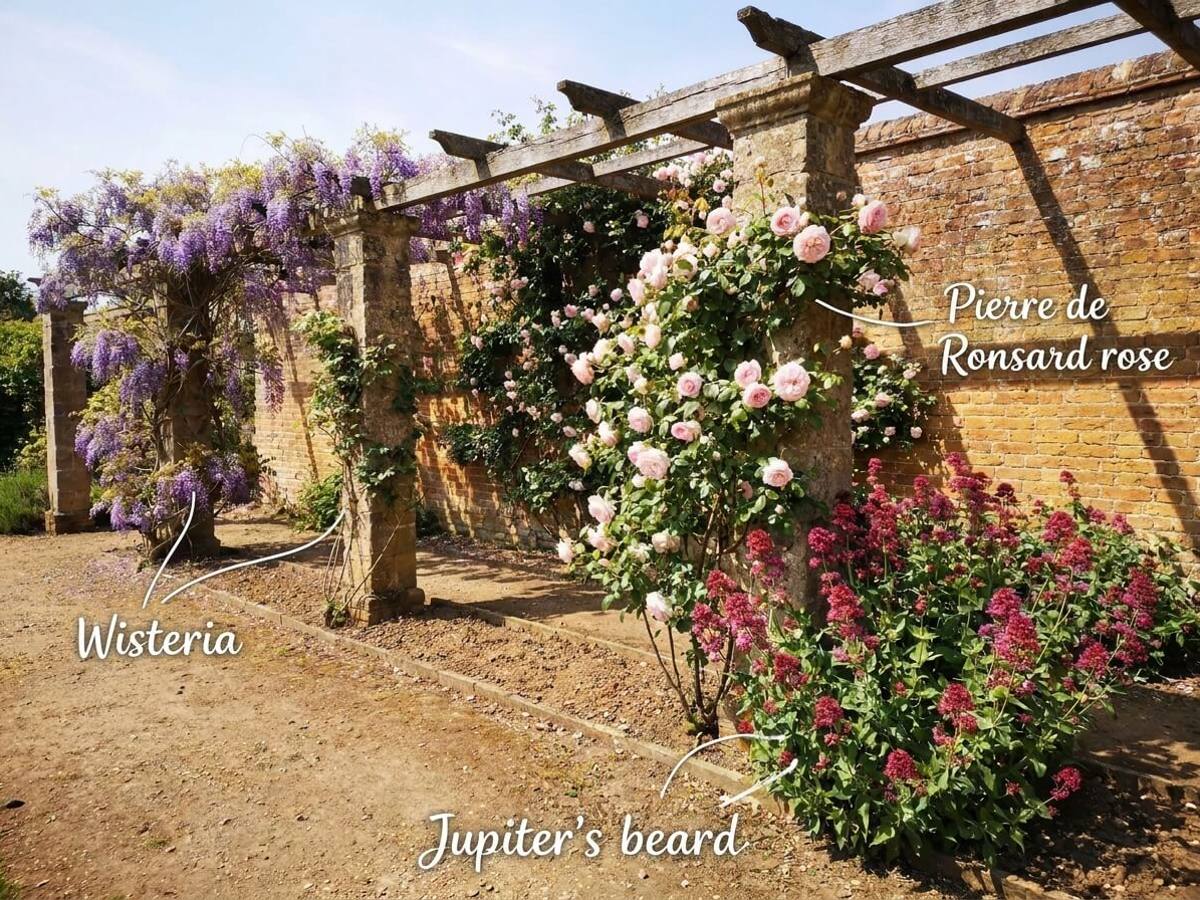
Allow the Wisteria a single planting position at one end of the structure and let it run 4 to 6 metres along the beams; tie the leading stems to the timbers with soft ties until they are woody enough to hold themselves. Give the Pierre de Ronsard rose about 2 to 3 metres of wall, fanned out on horizontal wires set 40 cm apart and 10 cm clear of the brick, with the main stems trained as near to horizontal as they will bend to force flowering shoots along their length. Plant Jupiter’s beard in a continuous ribbon along the whole base, roughly three plants per metre, 30 to 40 cm out from the wall so rain actually reaches the roots. Prune the Wisteria twice: shorten the whippy summer growth to about five leaves in July and August, then cut those same shoots back to two or three buds in winter, which is also when you remove any stem that has started to twine into the rose. Prune the rose in late winter, taking out dead and crossing wood and shortening the side shoots, and shear the Jupiter’s beard back hard after its first flush to get a second one.
In March the structure is bare and architectural: dark woody stems overhead, tied rose canes on the wall, and low grey-green tufts below. Late April and May bring the Wisteria’s hanging racemes, the single moment when the pergola does all the work. From late May the Pierre de Ronsard rose takes over at eye level and the Jupiter’s beard lights up the base, and that pairing carries through June and July with repeat flushes. August and September are mostly green canopy with scattered rose blooms, October brings yellow Wisteria foliage, and from November to February you are left with the bones — which, well tied and well pruned, are worth looking at in their own right.

