A hedge line that bakes in full sun from morning to evening is one of the hardest places in the garden to plant well. The soil dries fast, the light bleaches soft colours, and anything that sulks in heat will go bare at the bottom just when you want screening. A good scheme layers tough, sun-loving shrubs by height, so the tallest take the wind and glare while shorter, denser plants close the gap at knee and waist level — and between them they keep flowers coming right through the summer.
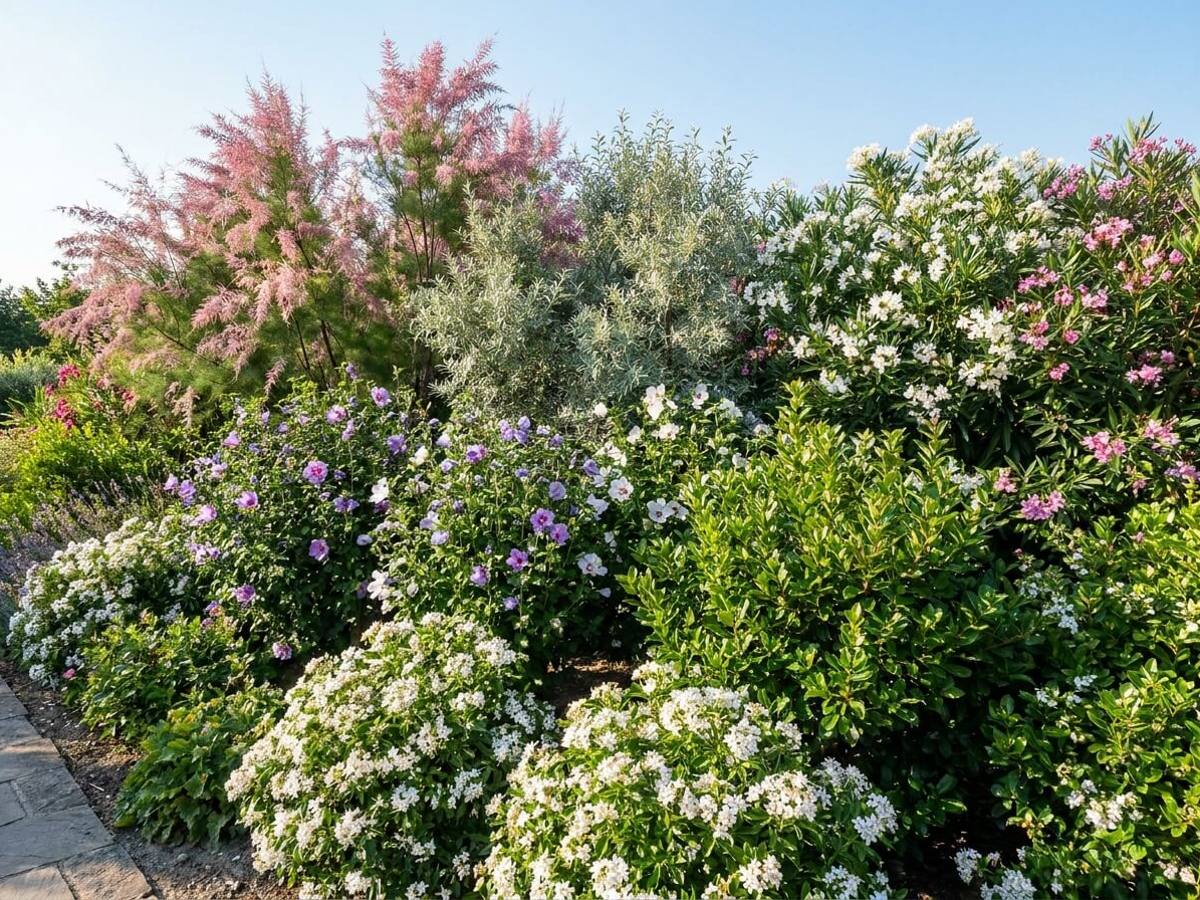
From back to front: Russian Olive, Tamarisk, Oleander, Hibiscus Althea, Escallonia, Choisya ternata.
Russian Olive is the back wall of this scheme. Its narrow, silver-grey leaves catch the light rather than absorbing it, which keeps the whole hedge looking cool even at midday, and the small summer flowers carry a strong sweet scent on warm evenings. It tolerates drought, wind and poor soil without complaint, so it shelters everything planted in front of it.
Tamarisk sits just forward of the tallest layer and brings a completely different texture: feathery, almost needle-fine foliage topped with clouds of tiny pink flowers. That haziness softens the solid mass of the hedge and stops it looking like a green wall. It thrives in dry, sandy, even salty ground, which makes it a natural partner for Russian Olive in the hottest, poorest part of the line.
Oleander is the long-haul flowering performer here, throwing out clusters of pink, white or red blooms from early summer well into autumn. Its leathery evergreen leaves hold their deep green through heat and give the hedge body at mid-height all year. Plant it where it gets maximum sun, and remember every part of it is toxic, so keep it away from paths used by small children and grazing animals.
Hibiscus Althea picks up the display in high summer, with wide open flowers in mauve, blue, pink or white that keep coming until the first cool nights. It is deciduous, so it needs evergreen neighbours either side to cover for it in winter — which is exactly what Oleander behind it does. Its upright, slightly stiff habit also slots neatly between taller shrubs without crowding them.
Escallonia forms the second-to-front layer, with small glossy evergreen leaves and clusters of pink or red summer flowers that bees work over all day. It clips well, so this is the plant that gives the hedge a defined, tidy edge if you want one. It also fills in densely low down, hiding the bare ankles that taller shrubs inevitably develop.
Choisya ternata finishes the front of the scheme with rounded, bright evergreen foliage that smells aromatic when you brush past. Its white starry flowers open in late spring and often repeat in late summer, bridging the gaps between the other flowering shrubs. In very hot, dry positions give it the slight shade cast by the taller layer behind, and it will stay lush rather than scorched.
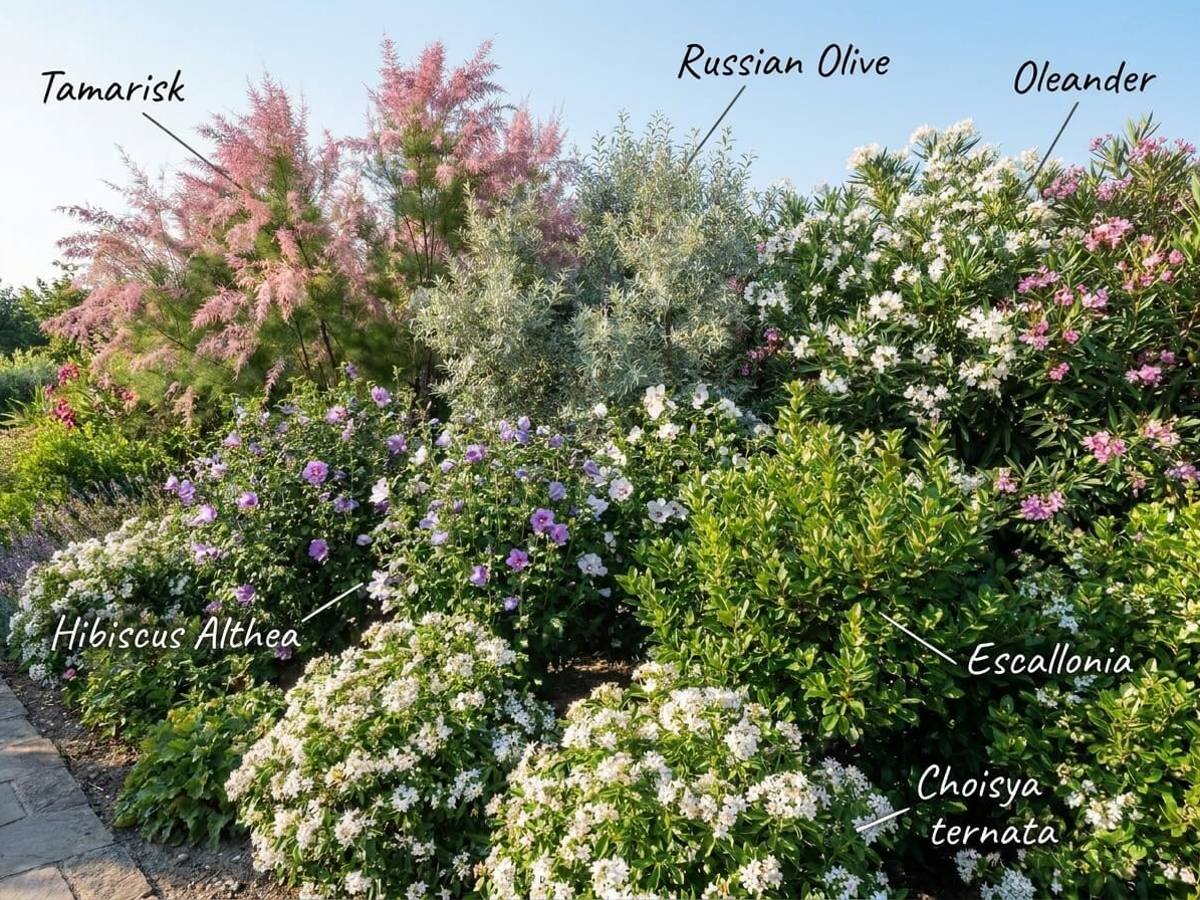
Work in three bands. Set Russian Olive at the back at about 2.5 m between plants, with Tamarisk slipped into the same line at roughly 2 m spacing, grouped in twos or threes rather than alternating one for one — that reads as a natural drift instead of a stripe. The middle band runs about 1.5 m forward: Oleander at 1.5 m apart, with groups of three Hibiscus Althea at 1.2 m spacing set between them so the deciduous plants are always flanked by evergreen. The front band sits another metre forward, with Escallonia at 1 m apart forming the continuous low edge and clumps of five Choisya ternata at 80 cm spacing at the corners and either side of any gateway, where the scent gets noticed.
In spring the hedge is mostly green and silver, lit by the white flowers of Choisya ternata and the scented flush on Russian Olive. Early summer brings the pink haze of Tamarisk and the first flush of Escallonia, then Oleander and Hibiscus Althea carry the colour through the hottest months and into early autumn. Once Hibiscus Althea drops its leaves, the evergreen front and middle layers keep the line solid, and through winter the structure holds up on foliage alone: glossy dark green at the front, aromatic rounded green behind it, and the pale silver tracery of the back row against the sky.