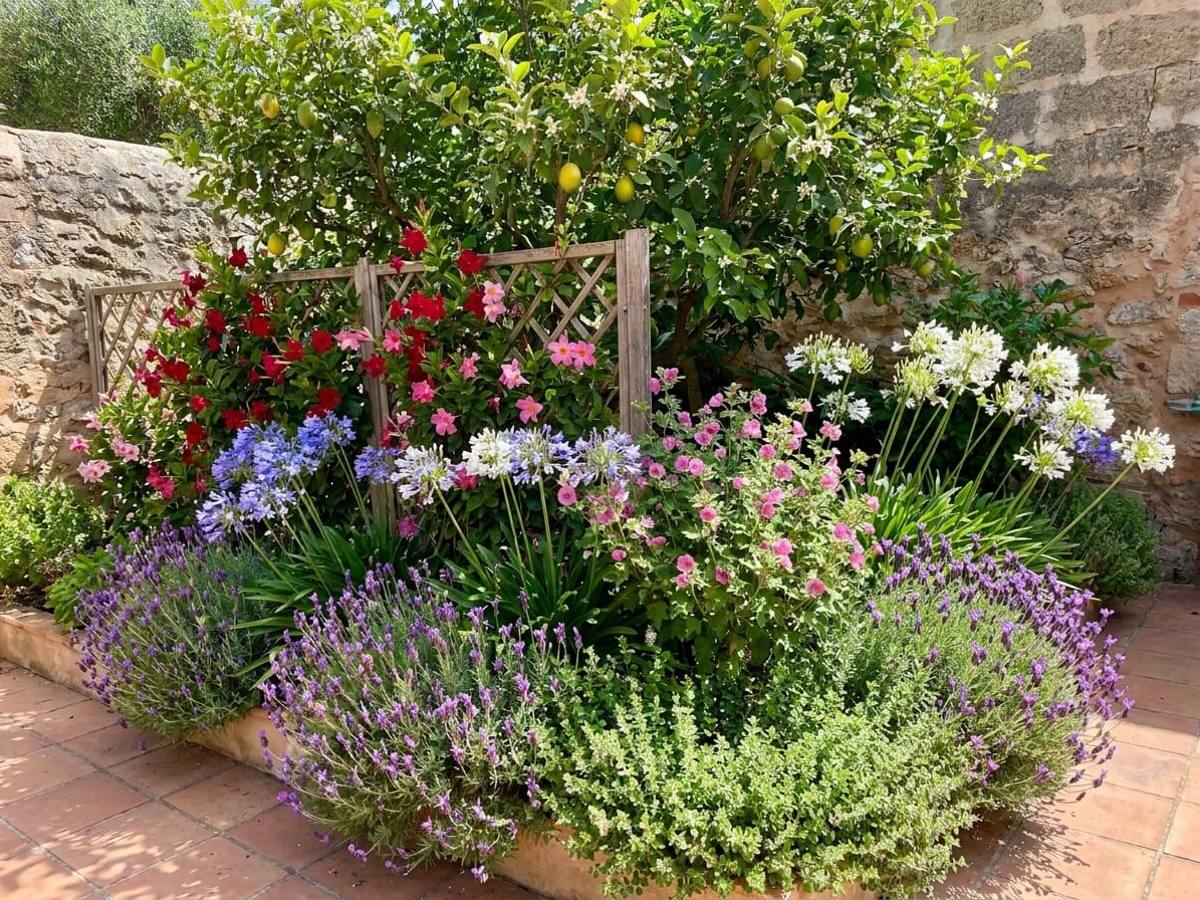
A south-facing patio or balcony in full sun is one of the hottest places in the garden: paving and walls bounce heat back at the pots, compost dries out by mid-afternoon, and anything that sulks in drought will show it within days. The trick is to build the scheme around plants that actively enjoy that heat, then stack them in height so the taller pots shade the compost of the smaller ones. Group the containers rather than spreading them along a wall, and the whole collection holds moisture better and reads as one planting instead of a row of odds and ends.
From back to front: Lemon tree, Mandevilla and dipladenia, Lily of the Nile, Cape mallow, French lavender, Marjoram.
A Lemon tree is the anchor of the group, giving year-round evergreen structure and a clear vertical presence at the back. Its glossy dark leaves make a solid backdrop that stops flowering plants in front from looking scattered, and the scent of the blossom carries across a small terrace on warm evenings. It needs the sunniest, most sheltered corner of all, so give it the warmest spot against a wall and let the other pots cluster around its feet.
Mandevilla and dipladenia brings the vertical flower colour, climbing a trellis or an obelisk through the whole of summer with trumpet blooms in white, pink or red. The glossy foliage matches the Lemon tree in texture, so the two sit together comfortably rather than competing. Set it where it can climb a railing or a wall panel just beside the Lemon tree, and the back of the scheme stays in flower long after the blossom has gone over.
Lily of the Nile throws its round flower heads up on bare stems in mid-summer, well clear of the foliage, which gives the middle of the group a layer of floating blue or white. It flowers best when the roots are tight in the pot, so it suits container life better than most perennials. The strappy leaves make a strong contrast with the small-leaved plants at the front, and the stems are tall enough to read against the dark Lemon tree behind.
Cape mallow is the workhorse of the scheme, covering itself in small mallow flowers for months on end in heat that would stop most shrubs. Its airy, loosely branched shape softens the gap between the upright Lily of the Nile stems and the lower pots. Clip it lightly after the first flush and it keeps producing; left unpruned it opens out and starts to look bare at the base.
French lavender gives the scheme its grey-green note and the tufted flower heads that catch low sun from the side. It starts flowering earlier than Cape mallow and Lily of the Nile, so it carries the display through late spring before the others get going. It wants sharp drainage and resents sitting wet, so keep it in its own pot with plenty of grit rather than sharing compost with thirstier neighbours.
Marjoram fills the front edge with low, soft mounds and small summer flowers that bees work from morning onwards. It takes the same baking sun and lean compost as French lavender, so the two can sit side by side with identical watering. Being within arm’s reach of the table, it also earns its place in the kitchen, and picking it regularly keeps the mounds tight.
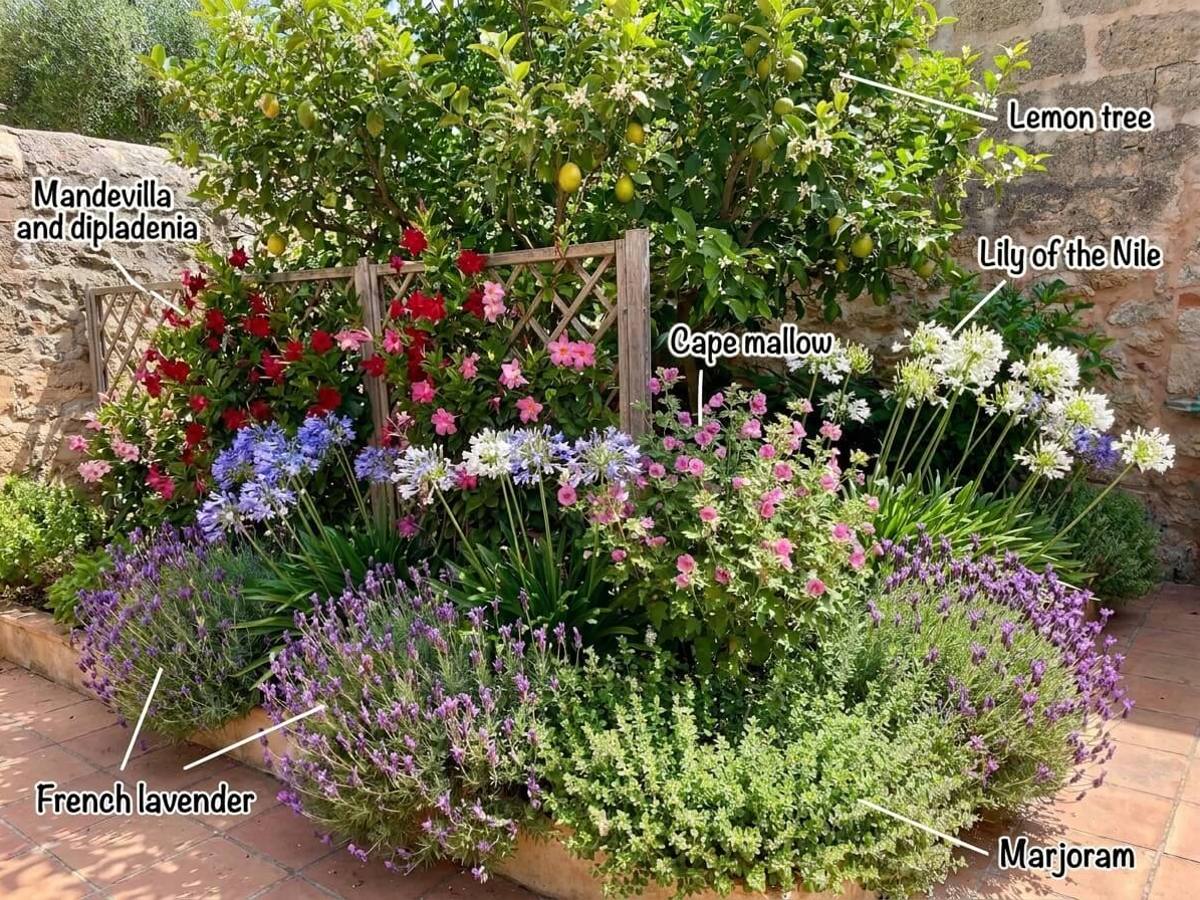
Start with the Lemon tree in a pot of at least 45 cm across, set in the warmest corner, and stand the Mandevilla and dipladenia beside it in a 35 cm pot with a 1.5 m obelisk or against a trellis panel. Place two pots of Lily of the Nile of about 30 cm in front and slightly to one side, so the flower stems break the line between the two tall plants. Bring Cape mallow forward on the other side in a 30 cm pot, then finish with three smaller pots of 20 to 25 cm along the front: two of French lavender and one of Marjoram, or the reverse if you cook with it often. Leave 10 to 15 cm between pot rims so air moves between them but the foliage still touches, and stand the thirstier Lemon tree, Mandevilla and dipladenia and Lily of the Nile on saucers while the French lavender and Marjoram go without.
In spring the French lavender opens first over the grey mounds at the front while the Lemon tree pushes new growth and scented blossom at the back. From June to September the scheme peaks: Lily of the Nile floats above the middle, Mandevilla and dipladenia climbs and flowers behind it, Cape mallow keeps going steadily and Marjoram froths along the front. Autumn empties it out as the perennials fade, and over winter the display rests on evergreen structure alone, the Lemon tree and the Mandevilla and dipladenia foliage moved to shelter, the lavender and Marjoram clipped back into neat grey cushions, the Lily of the Nile pots pushed to the back until they start into growth again.