A hedge line in full sun, with nothing to shade it from midday to evening, heats up fast and dries out faster. The soil at the foot of such a hedge is usually poorer than it looks, and the glare flattens any colour that is too pale. A good autumn scheme here leans on sun-lovers that keep flowering when the days shorten, layered by height so the whole band reads as one living screen rather than a row of separate shrubs.
From back to front: Strawberry tree, Oleander, Buddleia, Silverberry, Hibiscus Althea, Clerodendron, Graham’s sage.
At the back of the scheme, Strawberry tree gives you the structural height and a dense evergreen backdrop that holds the hedge together all winter. Its small white bell flowers open in autumn at the same moment the previous year’s fruit turns orange and red, so one plant carries two displays at once. The dark, leathery leaves make a quiet backing against which everything in front reads more clearly.
Oleander is the other tall evergreen in the back row, and it thrives on exactly the heat and reflected light that trouble other shrubs. It flowers from summer right through to the first cold nights, so it bridges the gap before the true autumn performers get going. Its narrow grey-green leaves contrast well with the broader foliage beside it.
Slot Buddleia into the back row wherever you need quick height while the evergreens fill out. Its long flower spikes carry on into autumn if you keep removing the faded ones, and they bring butterflies to the hedge at the end of the season. It is deciduous, so give it neighbours that stay clothed in winter rather than relying on it for screening.
The middle layer starts with Silverberry, whose leaves are splashed and flecked with silver and gold that catch full sun beautifully. Its flowers are tiny and almost hidden, but they open in autumn and scent the whole hedge line for weeks. It clips well, which means it can be the plant that keeps the middle of the scheme tidy while looser shrubs sprawl around it.
Hibiscus Althea is the main source of large, open flowers in the middle layer, blooming from late summer well into autumn in white, pink, mauve or deep purple-blue. It leafs out late and drops its leaves early, so the evergreens behind it matter. Plant it where the low afternoon sun will shine through the petals.
Towards the front of the middle band, Clerodendron opens heavily scented white or pink-tinged flowers in late summer and autumn, followed by bright blue fruits held in red calyxes. That fruit stage is one of the strongest moments in the whole hedge, and it arrives just as other flowers fade. Keep an eye on its suckers and pull them out while they are young so it does not push into its neighbours.
The front edge belongs to Graham’s sage, which flowers on and on until the first real frost. Its small deep red tubular flowers and dark calyxes sit low, softening the base of the hedge where taller shrubs go bare and leggy. It is happiest in hot, well-drained soil, exactly what you get at the sunny foot of a hedge line.
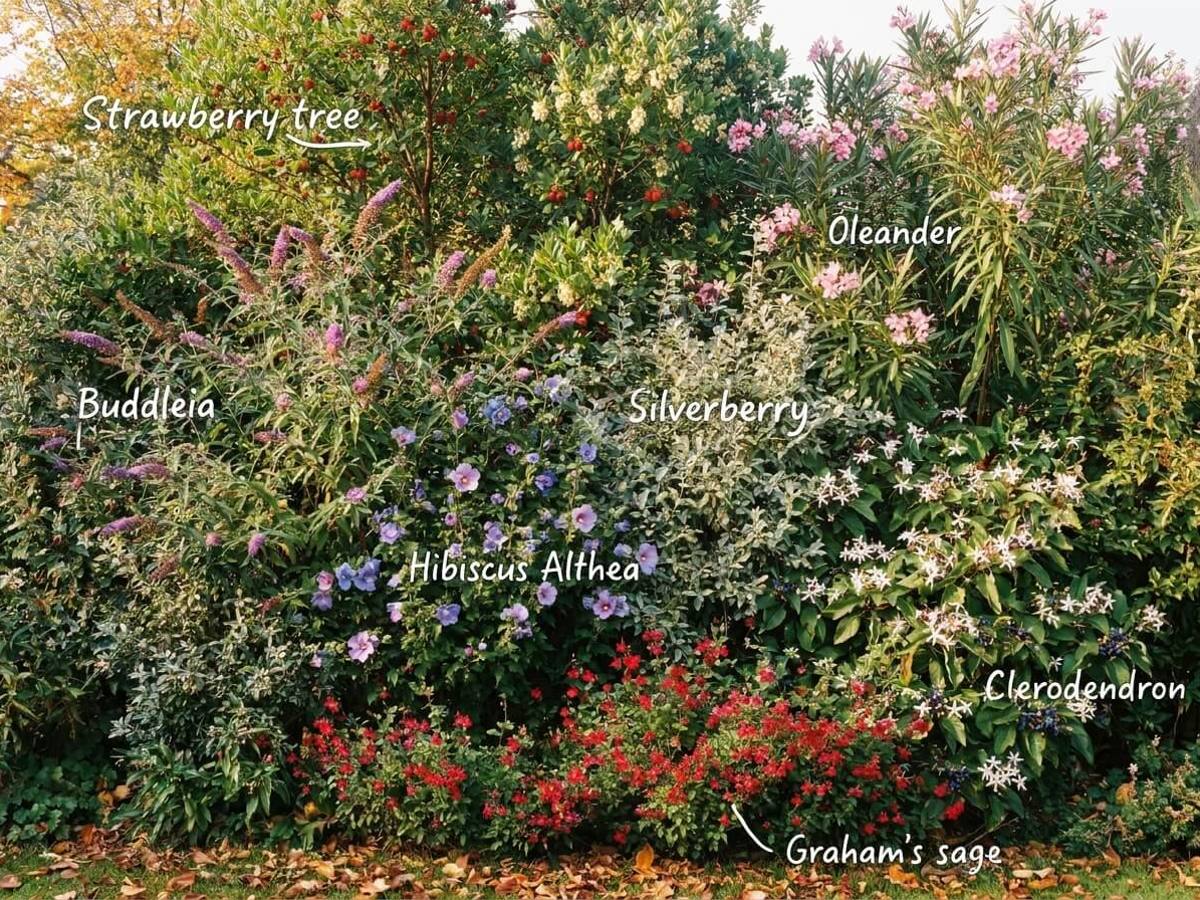
Work in three bands. Set the back row 2 m apart, alternating Strawberry tree and Oleander, with one Buddleia every 5 or 6 m to fill gaps while the evergreens mature. The middle band goes 1.2 m forward of the back row, spacing plants 1.5 m apart: run Silverberry in groups of three, then a group of three Hibiscus Althea, then three Clerodendron, repeating the sequence so no single shrub looks stranded. Along the front, plant Graham’s sage in drifts of five at 60 cm apart, concentrating them where the hedge meets a path and the scent and detail will be noticed.
In spring the hedge is mostly green: Strawberry tree, Oleander and Silverberry hold the shape while the deciduous shrubs break bud. Summer brings the first Oleander flowers and the opening spikes of Buddleia, with Hibiscus Althea joining in from late in the season. Autumn is the peak, with Hibiscus Althea still going, Clerodendron scented and then in blue fruit, Silverberry perfuming the air, Strawberry tree in flower and fruit together, and Graham’s sage red at ground level. Through winter the evergreen back and middle layers keep the screen solid, so the bare stems of Buddleia and Hibiscus Althea read as texture rather than as gaps.