A garden by the sea in full sun is a garden of extremes: salt-laden wind, light that bounces off the water and never seems to soften, and soil that drains almost as fast as you can water it. Anything leafy and thirsty will scorch at the edges by midsummer and sulk for the rest of the season. The scheme below leans into those conditions instead of fighting them, stacking wind-filtering shrubs at the back, silver and aromatic foliage through the middle, and tough, fleshy-leaved ground cover at the front, so the planting flowers hard all summer and still looks deliberate in January.
From back to front: Tamarisk, Lemon bottlebrush, Escallonia, Alyogyne, Perovskia, Lavender, Silver ragwort, Sea kale.
Put Tamarisk at the very back, where its open, feathery outline can take the first hit of the wind. It filters a salty gale rather than blocking it, which is exactly what the shrubs in front of it need, and in summer it clouds over with tiny pink flowers held on arching stems. The texture is so fine that it reads almost as mist against the sky, which keeps the back of the border from feeling like a wall. Everything planted in its lee will grow noticeably denser and greener for the shelter it gives.
Lemon bottlebrush sits just in front, bringing a heavier, more solid silhouette and narrow leathery leaves that shrug off salt spray. Its red flower spikes arrive from late spring and keep coming through summer, a hot colour that stops the scheme drifting into pastel. Place it slightly off-centre rather than dead middle, so the planting has a visual anchor without becoming symmetrical. The dark green of its foliage is the perfect backdrop for the silver plants further forward.
Escallonia is the workhorse of this back-to-middle zone: glossy, evergreen, and genuinely unbothered by coastal wind. Through summer it carries small pink or white bell flowers that bees work over all day. Use it to close the gaps between the taller shrubs so the border has a continuous green base in winter, when the perennials have gone. Its shine plays well against the matt, felted leaves that come next.
For something looser and more theatrical, Alyogyne throws out large mauve-purple hibiscus-like flowers through the warm months, each one short-lived but endlessly replaced. It wants the hottest, driest, best-drained pocket you can find, so give it the sunniest end of the middle rank. Its flowers are big enough to balance the fine-textured things around it and keep the eye moving. Tucked behind the aromatic shrubs, its slightly rangy base stays hidden.
Perovskia brings the see-through layer: white stems, grey-green cut foliage, and hazy blue-violet spires from midsummer well into autumn. It takes over flowering just as the earlier shrubs are winding down, which is what keeps this border from going flat in August. Plant it in a drift rather than as single plants, so the blue registers from a distance. It also softens the transition between the shrub mass behind and the low planting in front.
Lavender takes the front half of the middle rank, where you can brush past it and release the scent. Clipped into firm domes after flowering, it gives the scheme the structure it needs in winter, when much else is reduced to twigs. Its grey foliage echoes the silver further forward and its flower spikes repeat the vertical line of the taller blue planting behind. Keep it on the driest, grittiest ground you have.
Silver ragwort is the brightest foliage in the scheme, almost white in strong coastal light, with deeply cut, felted leaves. Use it as a repeating ribbon near the front edge to tie the whole planting together visually. It produces yellow summer flowers, which you can either enjoy or shear off to keep the focus on the leaves. Against the dark evergreen behind, it does more work than any flower here.
Right at the front, Sea kale gives a completely different texture: broad, waxy, blue-grey leaves with wavy edges, mounding low and wide. In early summer it sends up frothy domes of honey-scented white flowers that lift the whole edge of the border. It is a true shoreline plant, so the gravel and salt that trouble other things suit it perfectly. Plant it where its sculptural leaves can spill forward onto a path or gravel edge.
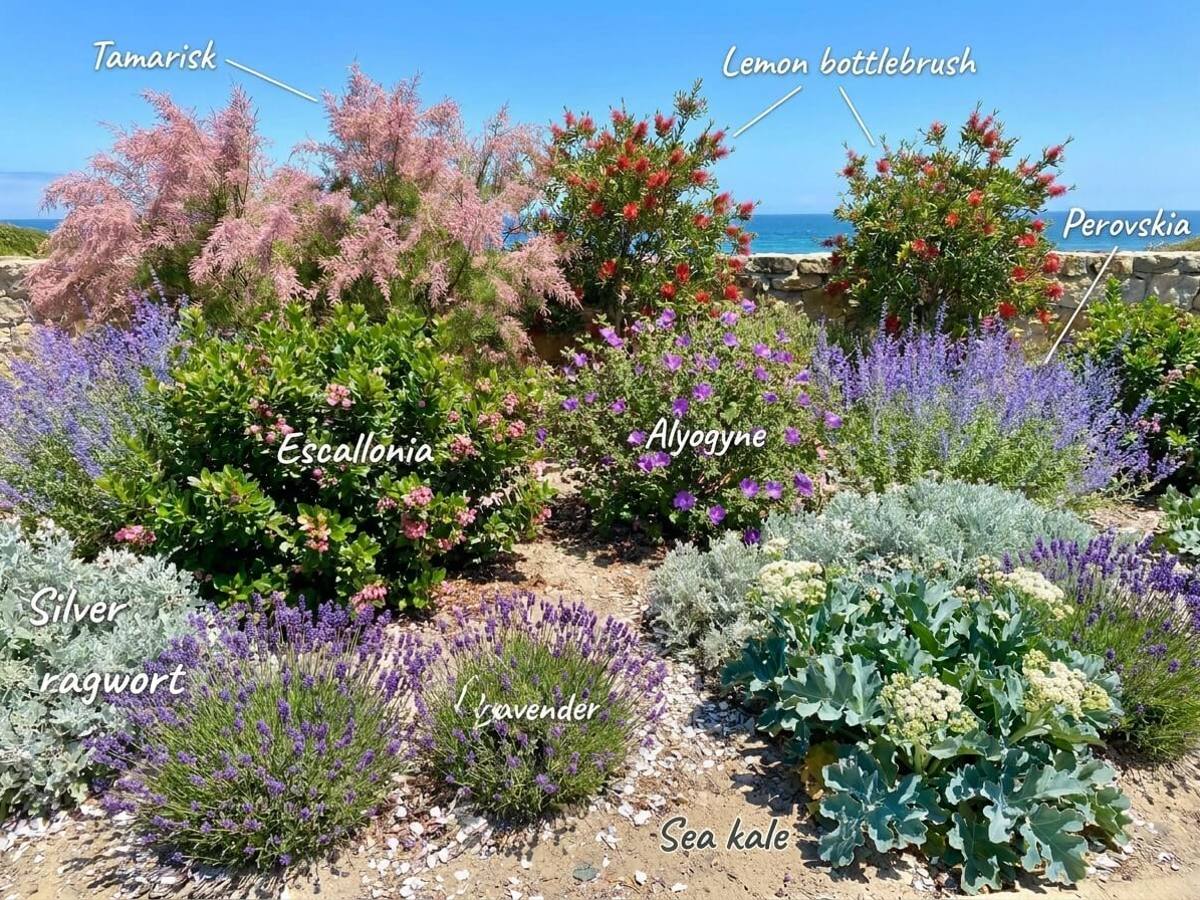
Work in three ranks on a border at least 3 m deep. Set Tamarisk at the back with 3 m between plants, with Lemon bottlebrush and Escallonia at roughly 1.5 m spacings in front of it, staggered so no two sit directly in line. Give Alyogyne its own warm pocket at the sunny end, then run Perovskia in groups of three to five plants at 60 cm apart across the middle. Lavender goes in a loose line or broken band at 45 cm spacings, Silver ragwort in repeated clumps of three at 40 cm, and Sea kale as single specimens at 60 cm along the front edge, where there is room for each mound to spread.
Spring opens quietly: fresh grey growth on Lavender and Silver ragwort, the glossy flush of Escallonia, and the first red spikes on Lemon bottlebrush. Early summer brings the white domes of Sea kale and the pink haze of Tamarisk, then Escallonia, Lavender and Alyogyne carry the high season, with Perovskia taking the border through late summer and into autumn on its pale stems. Cut nothing back too early — the bleached Perovskia skeletons and the seed heads hold the shape well into the cold months. Through winter the scheme still reads as a planting rather than bare soil, thanks to the evergreen mass of Escallonia and Lemon bottlebrush, the clipped grey domes of Lavender, and the persistent silver at the front.