A hedge line that sits in partial shade — against a north-east wall, under the high canopy of a neighbour’s trees, or along a fence that only catches the morning sun — is one of the trickiest places in a garden to furnish. Too little light for most summer-flowering shrubs, too much root competition for anything fussy, and a tendency to look flat and green from April onwards. The answer is to build the display around shrubs that flower early, before the leaves overhead have closed in, and to back them with evergreens that keep the line solid through the dark months.
From back to front: Silverberry, Camellia, Watanabe, Forsythia, Abeliophyllum Distichum, Maule’s quince, Cotoneaster.
Silverberry is the backbone of this scheme and belongs at the very back of the line. It is evergreen, dense and entirely unbothered by shade on one side, and the metallic sheen on the underside of its leaves bounces what little light there is back into the planting. Behind the flowering shrubs it acts as a permanent dark-green screen, so that pale spring blossom reads clearly instead of disappearing against a fence panel.
Partial shade is exactly where Camellia wants to be — full morning sun on frosted buds spoils the flowers, so a spot that warms slowly is a positive advantage. It brings glossy evergreen foliage all year and large, formal flowers from late winter into spring, in whites, pinks and reds. Set it just in front of the Silverberry, where the taller shrub shelters it from drying wind and the two evergreens together give the hedge real depth.
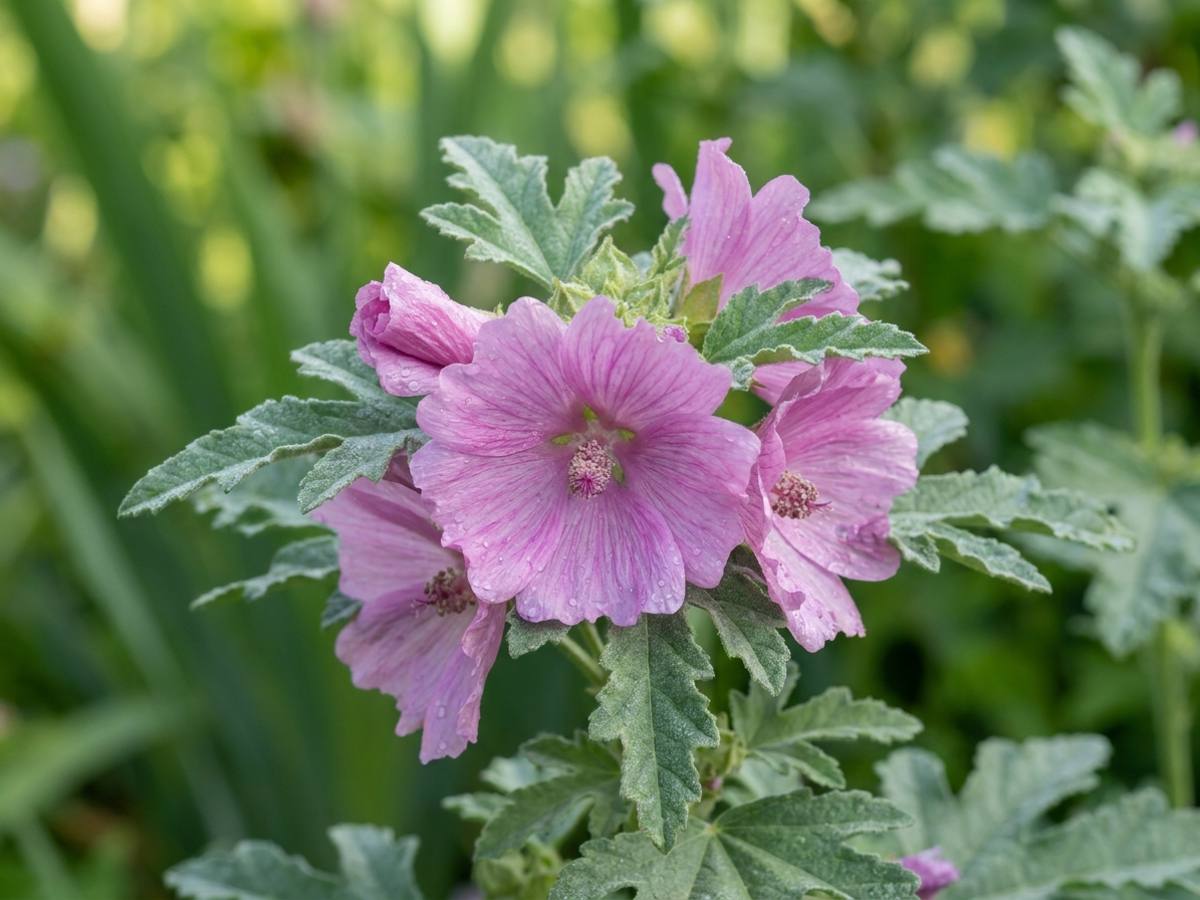
Watanabe introduces horizontal structure, with tiered branches carrying flat white lacecap flowers held above the foliage. It is the one plant here that breaks the vertical rhythm of the hedge, and that tiering shows up best when there is a solid evergreen behind it. Flowering runs on far longer than most of its neighbours, carrying the display from spring into early summer once the early shrubs have finished.
Forsythia is the loudest note in the scheme and the earliest big splash of colour, covering its bare stems in yellow before any leaf appears. It tolerates partial shade well, though it flowers more thickly on the end of the line that catches the most morning light, so place it accordingly. Keep it to a single group rather than spreading it along the whole hedge, or the yellow will overwhelm the quieter whites and pinks around it.
Abeliophyllum Distichum flowers even earlier, on bare wood, with small white blossoms flushed faintly with pink and a sweet scent that carries on still air. It is smaller and more slender than its yellow counterpart, so it sits in the middle ranks rather than at the back. Planted a short distance from the Forsythia, it gives you a white-and-yellow sequence through late winter and early spring without the two blocks of colour fighting.
Maule’s quince is low, spreading and thorny, and it carries cupped orange-red flowers directly on the stems in spring. That warm colour is valuable in shade, where pale flowers can look washed out and cold. Set towards the front of the hedge, it also closes off the base of the planting, which is where early hedges tend to go bare and leggy.
Cotoneaster finishes the front edge with small, neat foliage, modest spring flowers that bees work hard, and red berries that hold on well into winter. It copes with shade and poor soil better than almost anything else here, which matters at the foot of a hedge where roots are competing. Its job is continuity: when the spring shrubs are nothing but green, this is the plant still giving the line colour and texture.
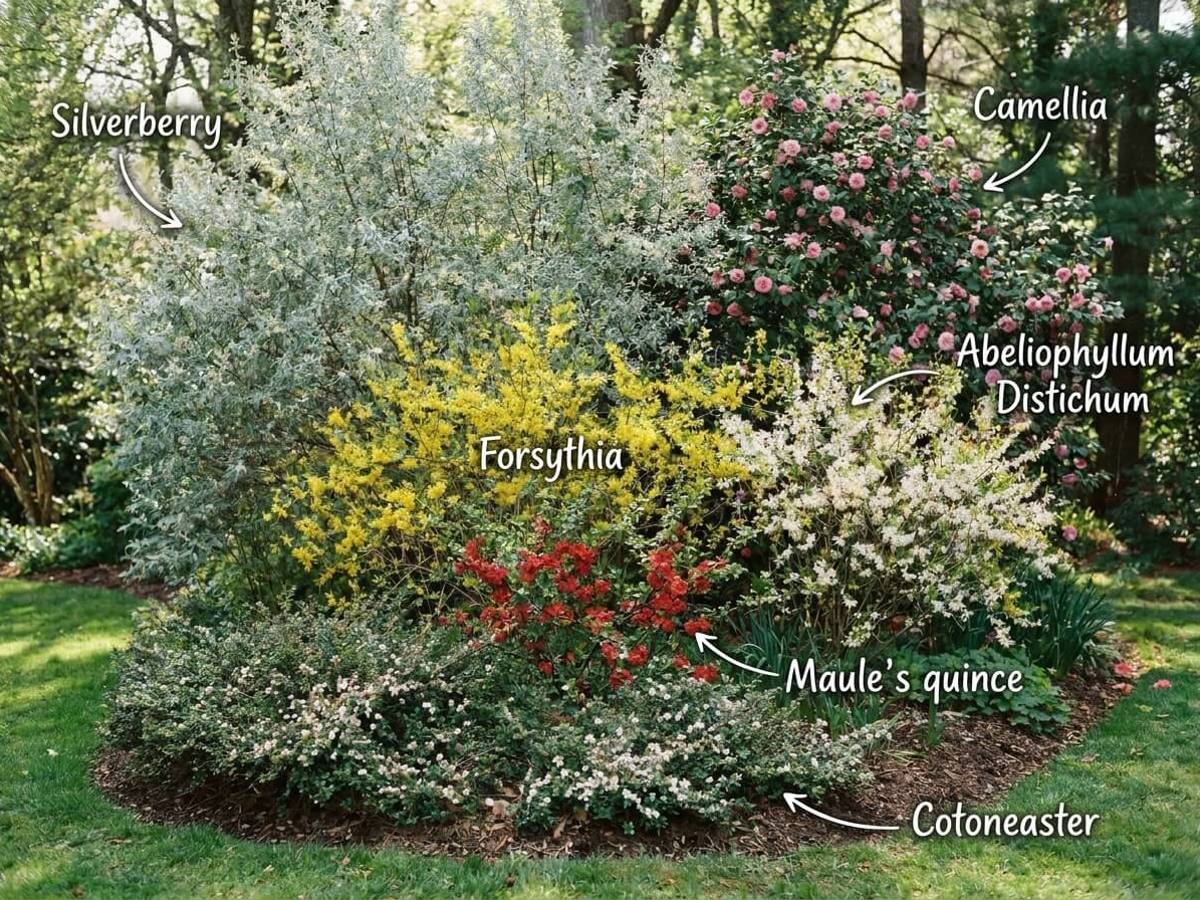
Work in three ranks along the line. Set the Silverberry at the back at roughly 1.5 m apart as a continuous screen, then bring the Camellia forward about 1 m in front of it, spaced 1.2 to 1.5 m apart, in a loose run rather than a rigid row. The middle rank takes the deciduous flowering shrubs: a group of three Forsythia at one end, a group of three Abeliophyllum Distichum towards the other, and a single Watanabe between them as a pivot point, all at about 1.2 m spacing. The front rank is low — Maule’s quince in groups of three at 80 cm to 1 m apart, with Cotoneaster filling the remaining gaps and running along the outer edge at a similar spacing. Allow the whole band roughly 2 to 2.5 m of depth and stagger each rank so no plant sits directly behind another.
From late winter the Abeliophyllum Distichum opens first on bare stems, overlapping with the earliest Camellia buds. Forsythia follows with its block of yellow, then Maule’s quince picks up the warm end of the palette near the ground, and Watanabe takes the display through into early summer with its tiered white lacecaps. Through high summer nothing is in flower and the hedge works purely on texture — glossy Camellia leaves, the silver reverse of the Silverberry, the pleated foliage of the Watanabe and the fine mesh of the Cotoneaster. Autumn brings berries on the Cotoneaster and leaf colour from the deciduous shrubs, and winter falls back to the two evergreens at the rear, which keep the line solid until the cycle starts again.