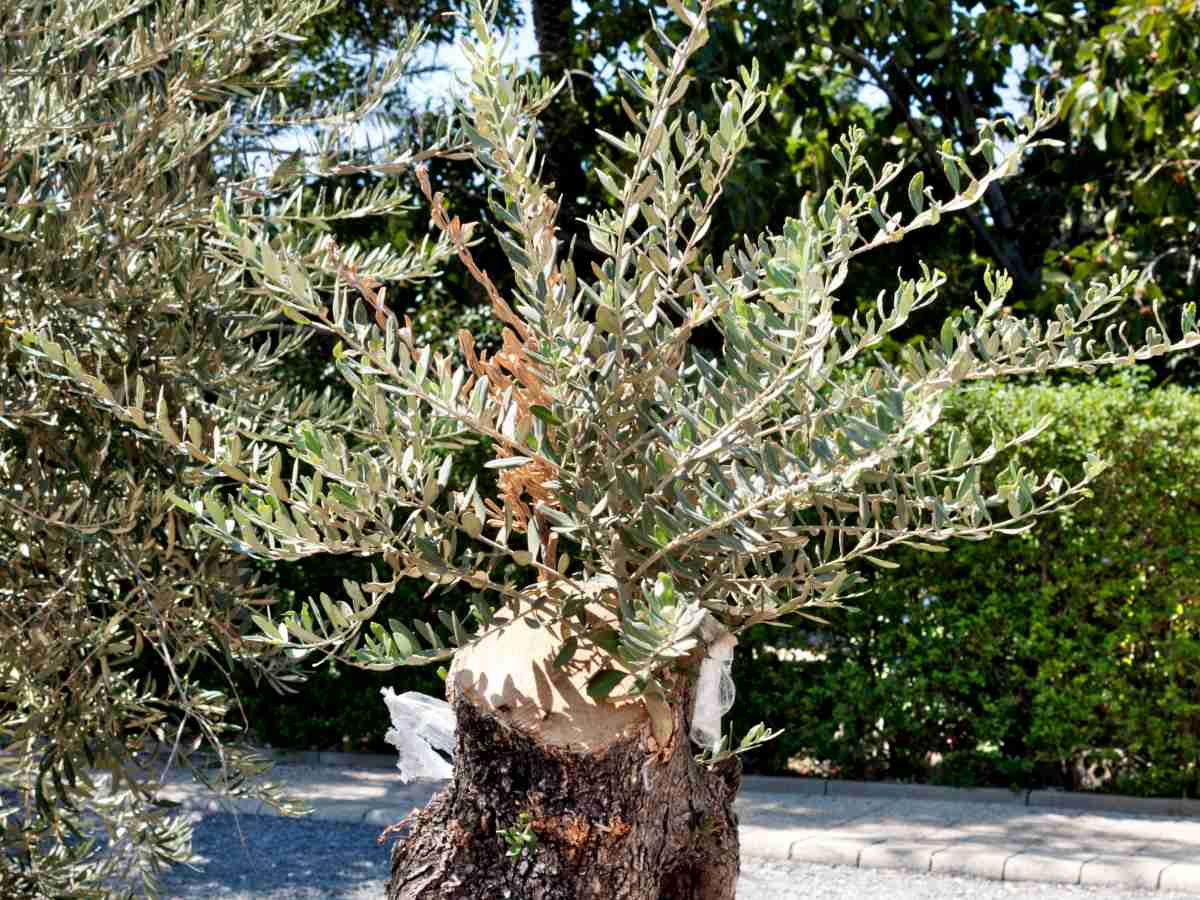
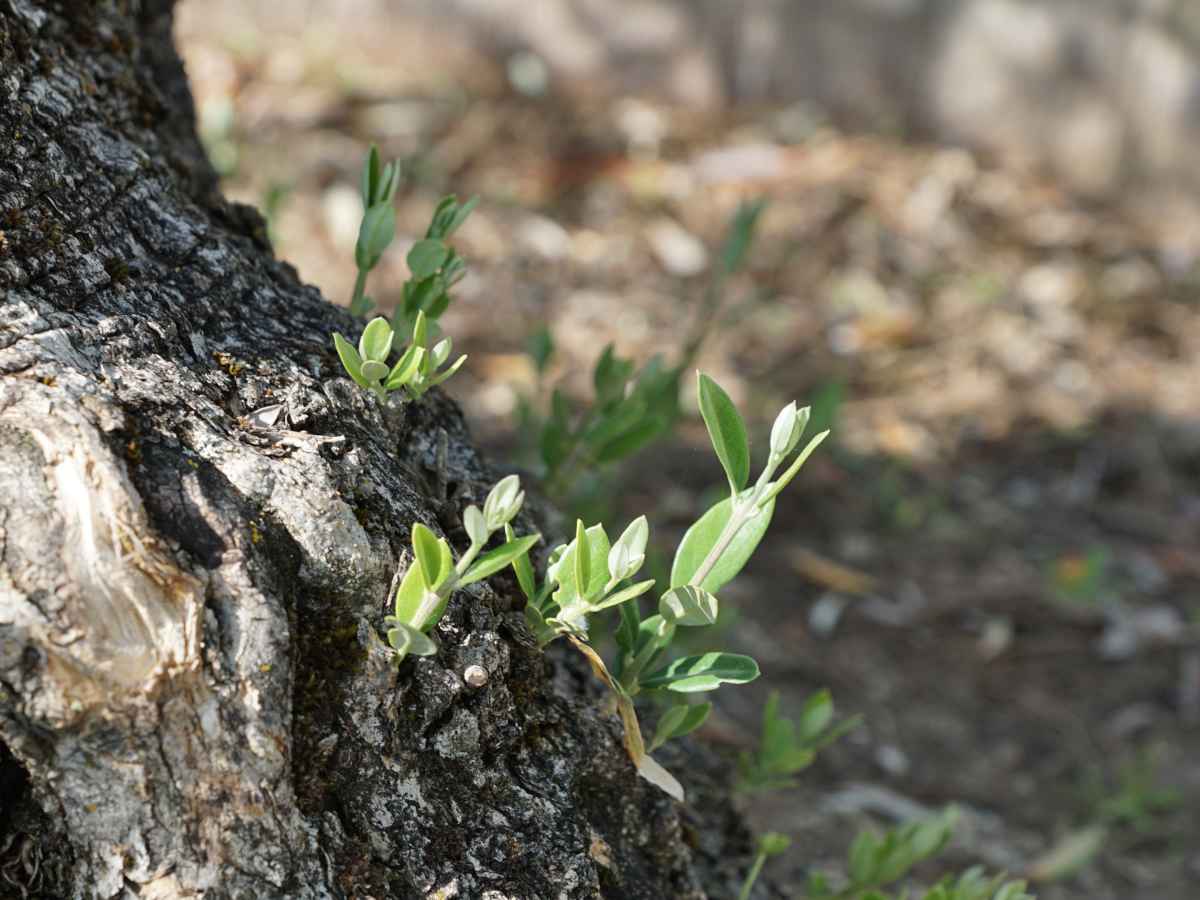
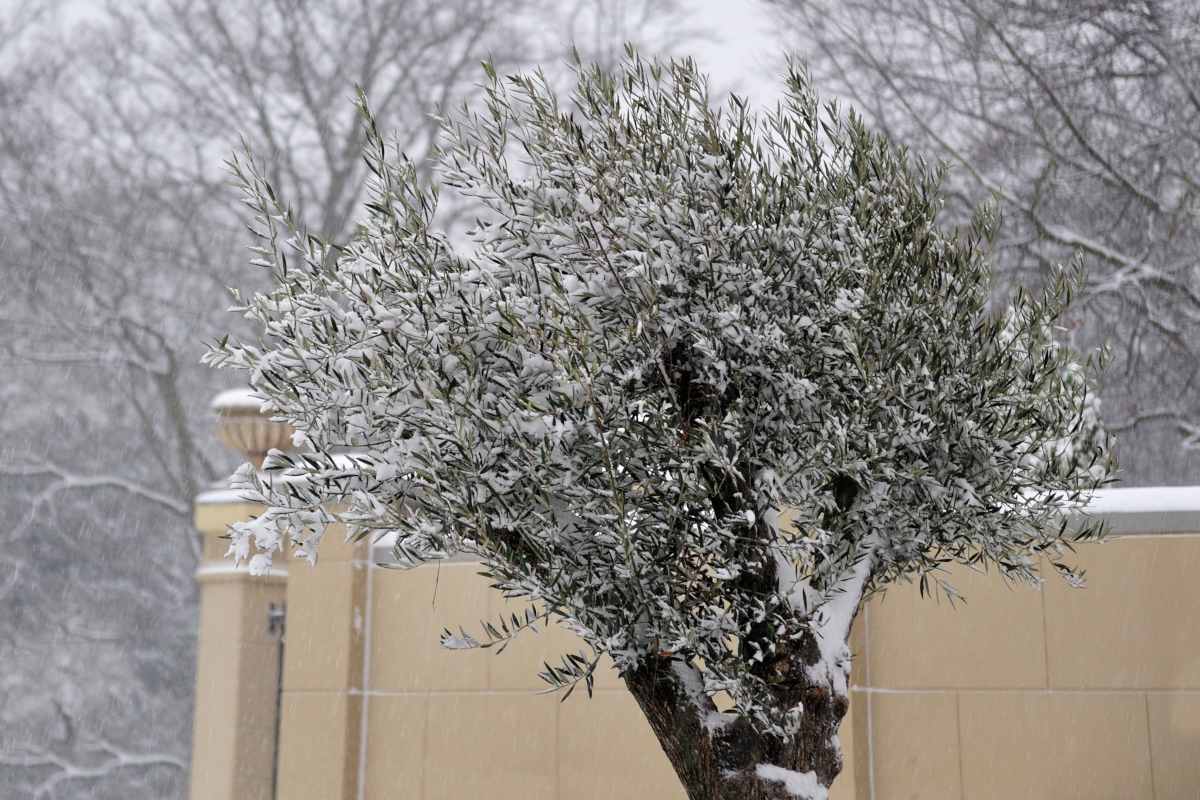
Fresh sprouts push up from the dead stump and from roots nearby, each one fed by a root system that is already in place. Regrowing a frost-killed olive (Olea europaea) from the stump beats replanting: wait until the last frosts have passed before cutting, and the tree comes back faster and hardier than before.
Growing a frozen olive tree back from the stump ensures it will be hardier.
The regrown olive tree will resist cold weather and freezing better in the future.
As an added benefit, it’ll grow back faster than planting a new tree from scratch would: the root system is already in place.
If the tree was grafted, hopefully part of the grafted variety is still alive. If not, you’ve lost that and only the root stock will grow back.
Cut the dead tree trunk off cleanly, half a foot (15cm) above either the graft joint or ground level, depending on whether it was grafted or not.
You might need to do this in two steps, first tumbling off the most part of the dead olive tree, then making a clean slice for the stump. Notch the bark before cutting large pieces off, so that slivers of bark aren’t pulled off from the trunk as they fall.
If your tree was grafted, see steps in the following paragraph; if not grafted, skip it and follow steps in the one after it.
Regrowing grafted olive stumps
This is for grafted olive:
Keep every sprout above the graft joint the first year
Sprouts may have grown above the graft joint. Keep all of those in the first year.
Cut any growth from the undesirable root stock.
In the 2nd year, select 3 or 4 nice shoots and cut off any other ones.
In the 3rd year, select the most vigorous growth from the grafted part and cut other ones off.
Train and prune this single stem in the following years to create new scaffold branches and fruiting branches.
If no shoots sprout back from the grafted part, let the root stock grow back as described below. Once it has grown back, graft the desired variety on top of that. Your new graft will benefit from part of the old rootstock’s cold-hardy experience!
For non-grafted olive trees
In spring, sprouts will come up from the stump and from nearby roots. The first year, keep all new stems.
In the 2nd year, remove all stems immediately on the stump. Keep those that are further off and that grew from the roots.
In the 3rd year, select and keep 4 to 6 of the most vigorous stems, each coming from a different root.
In the 4th year, select the most vigorous stem and start training it as you would a young olive tree.
You can cut the other 3 to 5 stems and their root away from the original stump, and use them to plant new olive trees further off.
Basically, you’re letting the frozen olive tree grow back from its roots, as if you were preparing a root cutting.
Grafted or not: what to do each year after the freeze
Once the dead trunk has been cut back, the follow-up differs depending on whether your olive tree was grafted or grown on its own roots. Use this year-by-year summary to know which shoots to keep and which to remove.
Grafted or not: what to do each year after the freeze
Year after cutting back
Grafted olive stump
Non-grafted olive stump
1st year
Keep every sprout that has grown above the graft joint, and cut any growth coming from the undesirable root stock
Keep all new stems, whether they come up from the stump or from nearby roots
2nd year
Select 3 or 4 nice shoots and cut off any other ones
Remove all stems growing immediately on the stump, keep those further off that grew from the roots
3rd year
Select the most vigorous growth from the grafted part and cut the others off
Select and keep 4 to 6 of the most vigorous stems, each coming from a different root
4th year and after
Train and prune the single stem to create new scaffold branches and fruiting branches
Select the most vigorous stem and train it as a young olive tree; the other 3 to 5 stems can be cut away with their root and planted further off
In both cases the aim is the same: funnel the energy of an intact root system into one strong, well-placed stem.
Conclusion
With these techniques, you’ll be able to grow olive trees at the threshold of their climate zones. With luck, some of them will live to be 1000 years old!
Do not expect a harvest straight away: olives flower on shoots grown the previous season, so a newly regrown stem cannot fruit in its first year and will need at least another season’s growth.
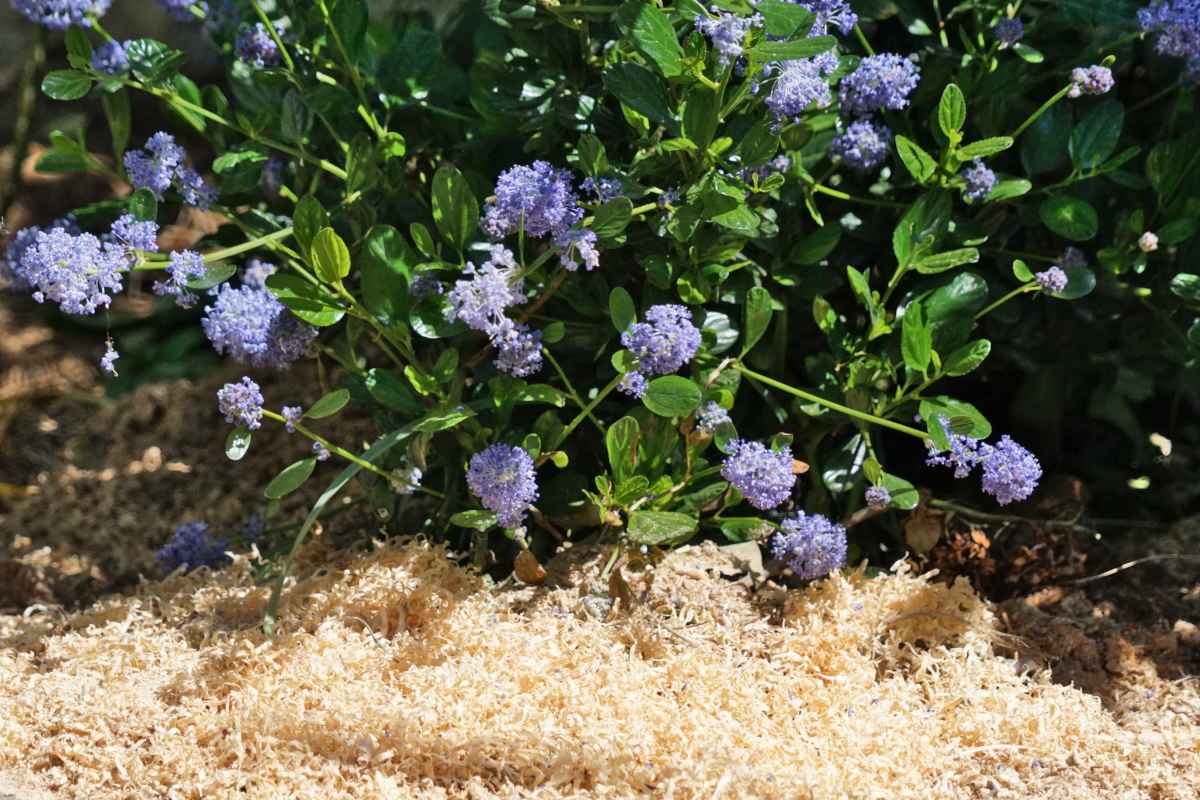
Mulch the ground around the regrowing olive stump with straw or bark to conserve soil moisture and moderate root temperature, keeping the mulch a few inches clear of the stump and any shoots to avoid constant moisture against the bark.
If the olive tree has been felled or killed back to the stump, protect the tender basal shoots from rabbits, deer and strimmers by marking the stump with a stake or wire cage.
Go easy on nitrogen-rich fertiliser while the olive is regrowing, as it pushes soft sappy shoots that ripen poorly and are the first to be damaged by the next hard frost.
Written by Gaspard Lorthiois | Loves helping out, especially when it comes to growing things. Worked in herbal medicine, runs a farm, and dabbles in tech. Master's degree and engineer.