Puschkinia scilloides: spring bulb care and planting guide
0
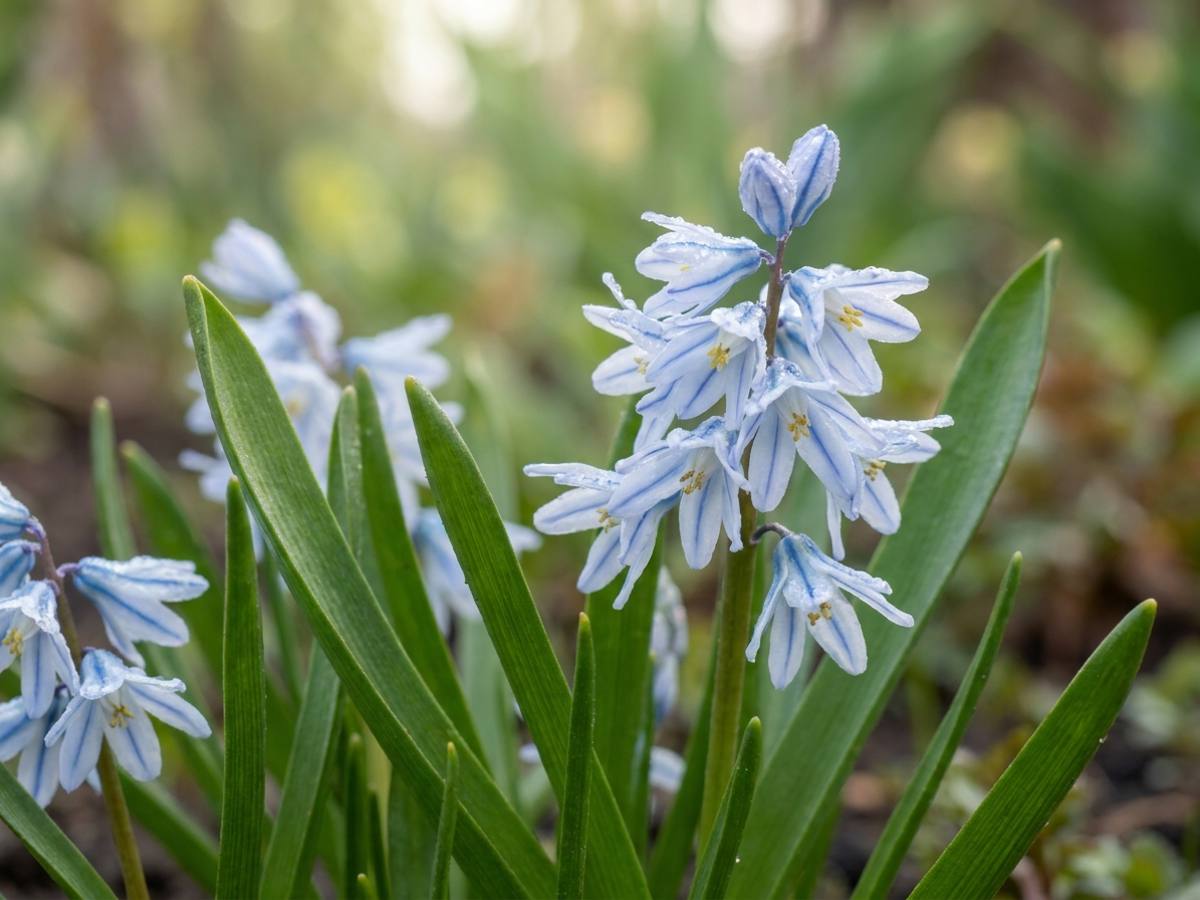
Puschkinia scilloides is one of the quiet stars of the early spring garden, throwing up tight spikes of pale ice-blue bells, each petal marked with a deeper cobalt stripe down its centre. Barely 15 cm tall, it is a bulb for the front of borders, gravel gardens, rock gardens and grass, where it naturalises willingly into gentle drifts. Its distinctive trait is that striping — from a distance the flowers read as white, but close up they are finely pencilled in blue.
Growing conditions
Puschkinia flowers before deciduous trees and shrubs come into leaf, so it copes happily with positions that are shaded in summer but bright in early spring. Full sun gives the sturdiest, most upright spikes, whilst dappled shade under deciduous shrubs produces slightly taller stems and longer-lasting flowers. Deep, evergreen shade is the one situation to avoid.
Drainage matters far more than fertility. This is a bulb of stony mountain meadows in the Caucasus, Turkey, Iran and Lebanon, so it thrives in gritty loam, sandy soils and thin chalky ground, at a pH from neutral to distinctly alkaline. Heavy, sticky clay that stays wet in winter is the main cause of failure.
Once established it is remarkably tough, shrugging off hard frosts, late snow and the summer drought of a baked border. In regions with very wet, mild winters, plant on a slope, in raised beds or in a gravel garden to keep the dormant bulbs on the dry side.
How to plant Puschkinia
Plant dry bulbs in early to mid autumn, ideally September or October, so they can root before the soil chills. Puschkinia bulbs are small and dry out quickly in the packet, so buy early and plant promptly rather than leaving them in a shed.
Spacing: set bulbs 5–8 cm apart in groups of at least 20–25; they look mean as single specimens and need proximity to read as a drift.
Depth: plant 5–8 cm deep, nose upwards — roughly three times the height of the bulb.
Soil preparation: fork over the top 15 cm and work in a couple of handfuls of horticultural grit per square metre on heavier ground; skip the rich compost, which encourages leaf at the expense of flower.
Watering in: water once after planting to settle the soil, then leave alone — autumn rainfall is normally ample and soggy bulbs rot.
Propagation: lift congested clumps as the foliage yellows in late spring, separate the offsets by hand and replant immediately at the same depth; self-sown seedlings flower in their third or fourth year.
Puschkinia scilloides growing in a naturalistic garden border
Care through the seasons
Spring: Growth appears in late winter and flowering follows quickly, needing no intervention at all. A light scatter of general-purpose organic fertiliser or bonemeal as the shoots emerge helps bulbs bulk up for the following year. Leave the flower spikes in place if you want self-seeding, or snip them off if you would rather keep the colony tidy and contained.
Summer: The critical rule is to let the leaves die down naturally — never tie, knot or mow them off before they have yellowed, usually by early June. Once dormant, Puschkinia wants dry warmth and needs no watering whatsoever. Mark the position with a label so you do not dig into the bulbs when planting summer bedding.
Autumn: This is the season for planting new bulbs and for splitting overcrowded colonies that have started to flower less freely, typically after four or five years. A thin mulch of leafmould or garden compost over the planting area feeds the bulbs and suppresses weeds, but keep it shallow — no more than 2–3 cm — so emerging shoots are not smothered.
Winter: The bulbs are fully dormant and completely hardy, requiring no protection even in exposed gardens. Container-grown bulbs are best stood in an unheated frame or against a wall to keep winter rain off the compost.
Best varieties to grow
There are few named cultivars, but the variants that exist differ noticeably in colour and vigour.
Puschkinia scilloides var. libanotica — the form almost always sold commercially, with milky-blue flowers and crisp navy stripes; reliable, vigorous and excellent for naturalising.
Puschkinia scilloides var. libanotica ‘Alba’ — a pure white selection with no striping, superb for lighting up shady corners and beautiful beside black hellebores.
Puschkinia scilloides var. scilloides — the eastern form, a little taller and often bluer overall, with a looser, more graceful spike.
Puschkinia peshmenii — a closely related Turkish species for the alpine house or a sharply drained trough, flowering earlier with broader, ice-white bells.
Pests, diseases and common problems
Bulb rot and basal rot: bulbs turn soft and mushy and shoots fail to appear, almost always from winter waterlogging. Improve drainage with grit, replant on a slope or in raised beds, and discard any soft bulbs at planting time.
Slugs and snails: they graze ragged holes in the tender young leaves and flower buds in damp springs. Clear leaf litter and hiding places nearby, water in nematodes, or scatter wool pellets around emerging clumps.
Non-flowering or blind clumps: leaves appear but flowers do not, usually because of overcrowding, foliage removed too early, or shade that has deepened as neighbouring shrubs matured. Lift and divide in early summer, feed as growth begins, and thin overhanging branches to restore spring light.
🌿 Nature & Garden Newsletter
Gardening tips, recipes & seasonal advice, twice a week.