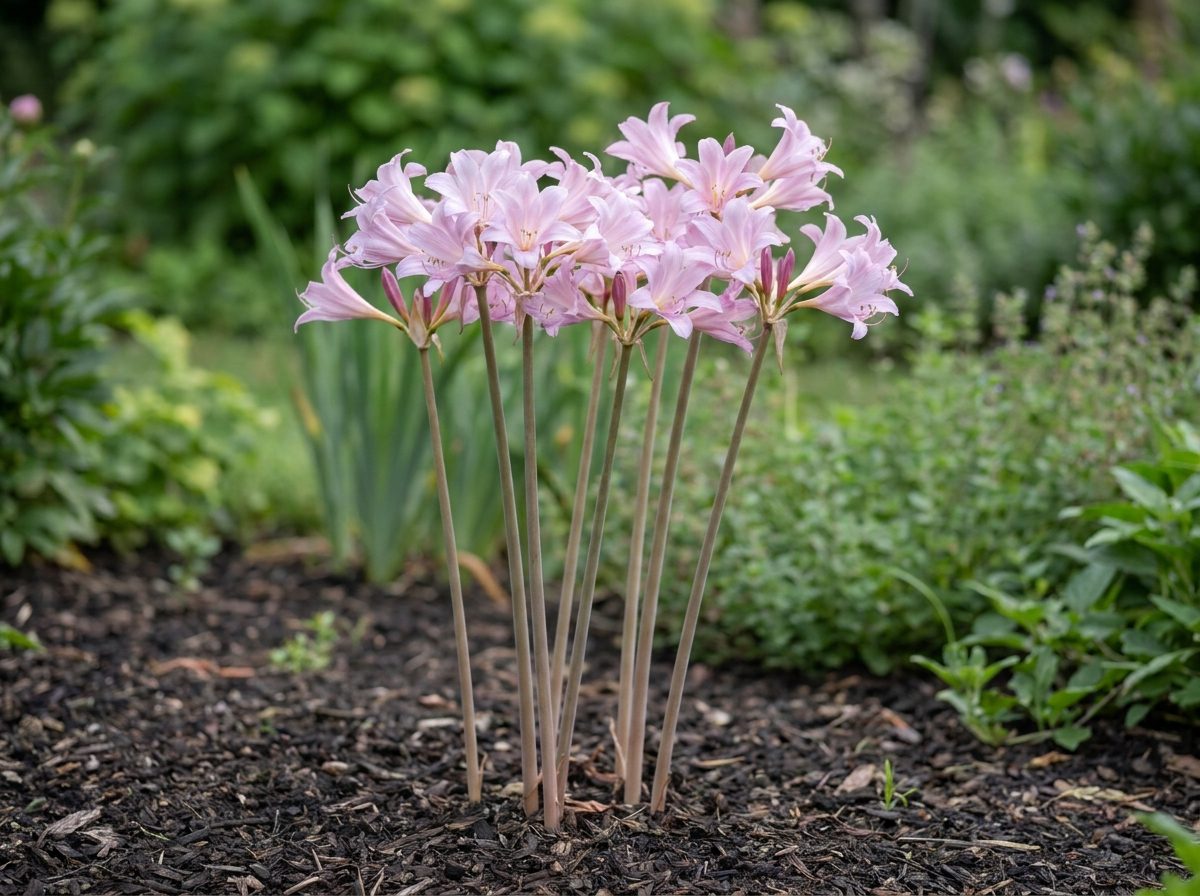
Few bulbs stage a comeback quite like Lycoris squamigera. Its strap-shaped grey-green leaves appear in spring, vanish by midsummer, and then — seemingly from bare earth — bare stems shoot up in August carrying trusses of fragrant, lilac-pink trumpets washed with blue. It is a superb plant for the front of a sunny border or beneath deciduous shrubs, where it fills the late-summer gap with almost no effort.
Growing conditions
Give Lycoris squamigera the sunniest position you can spare, or light shade cast by deciduous trees and shrubs. The spring foliage must bank enough energy before it dies down, so the site needs good light from March to June. Deep or evergreen shade is the single commonest cause of flowerless clumps.
Drainage matters more than fertility. A gritty loam, sandy soil or chalk bank all suit it, provided water never sits around the bulbs in winter. It is relaxed about pH, performing well anywhere between slightly acid and distinctly alkaline, roughly pH 6.0–7.5.
This is the hardiest of the Lycoris clan and succeeds where red spider lilies fail, taking hard frosts down to around −25 °C under a mulch. In mild, damp maritime climates give it the hottest, driest spot available — a south-facing wall base or the edge of a gravel garden — to ripen the bulbs through summer.
How to plant Lycoris
Plant dormant bulbs from early summer to early autumn, in the window between the foliage withering and the flower stems rising. Bulbs bought in growth or with roots attached should go in the ground the moment they arrive, as they dislike long storage.
Space bulbs 20–25 cm apart; crowded clumps compete and sulk, whilst this distance allows several years before division is needed.
Set the top of the bulb 10–13 cm below the surface in cold gardens; in mild regions the neck can sit just at soil level.
Fork in grit or coarse sand on heavy ground and add a handful of garden compost beneath — never fresh manure, which encourages basal rot.
Water in once to settle the soil, then leave dry until growth begins; waterlogged dormant bulbs rot quickly.
Propagate only by lifting offsets from congested clumps in early summer, immediately after the leaves yellow — seed is not an option, as the plant is sterile.
Lycoris squamigera growing in a naturalistic garden border
Care through the seasons
Spring: Broad, glaucous leaves push through in March and April and do all the year’s work. Apply a balanced general fertiliser or a potassium-rich feed as growth starts, and keep the area weeded so nothing shades the foliage. Resist tidying the leaves, however untidy they look as they fade.
Summer: By late June the foliage has gone and the bulb enters a dry rest — exactly what it wants. Avoid irrigating the spot, and never plant thirsty bedding over the top. Bare flower stems appear within days of August rainfall; deadhead them once the last trumpet drops, leaving the stalk to wither naturally.
Autumn: Cut the spent stems at the base once they are soft and straw-coloured. This is the moment to mark clump positions with a label or a low companion plant, so you do not spear the bulbs with a fork later. Divide overcrowded colonies only if flowering has dropped off, accepting a season or two of sulking afterwards.
Winter: The bulb is entirely below ground and needs nothing beyond a 5 cm mulch of leaf mould or bark in gardens that regularly drop below −15 °C. Keep the mulch loose so the crown does not stay sodden.
Best varieties to grow
Named cultivars are scarce because the plant is sterile, so most gardeners widen their season by adding related species.
Lycoris squamigera — the straight species remains the benchmark: fragrant, lilac-pink and the most cold-tolerant of the genus.
Lycoris sprengeri — smaller and later, with rose-pink petals that fade to an unmistakable electric blue at the tips.
Lycoris chinensis — spidery golden-yellow flowers on 50 cm stems, with spring foliage like L. squamigera.
Lycoris longituba — tall white trumpets with very long tubes; elegant, and hardier than most white-flowered kinds.
Lycoris radiata — the classic scarlet spider lily, worth growing where winters stay above about −10 °C.
Pests, diseases and common problems
Narcissus bulb fly: Grubs hollow the bulb, producing weak, grassy leaves and no flowers. Firm the soil over the neck as foliage dies back in June so egg-laying females cannot reach it, and destroy any soft bulbs on lifting.
Basal and bulb rot: Brown, mushy scales and collapsing stems follow winter waterlogging. Lift and discard affected bulbs, and replant survivors on a raised bed or generous layer of grit.
Slugs and snails: They rasp the soft flower stems overnight, toppling blooms just as they open. Patrol at dusk in warm, damp August weather and use wool pellets or a gravel collar around emerging stems.
Failure to flower: Usually caused by recent transplanting, too much shade, or leaves removed before they yellowed — be patient, improve light, and leave the foliage alone until midsummer.