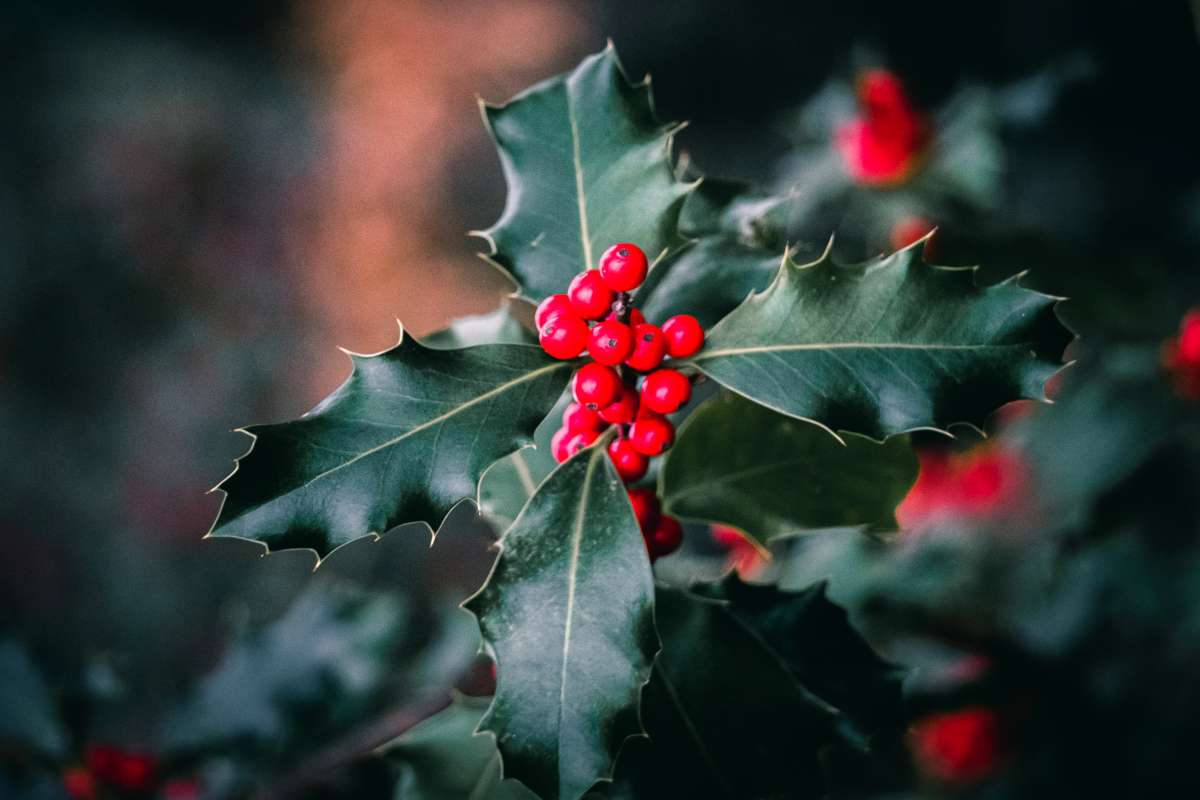
Glossy, spine-edged leaves and radiant red berries hold their colour through winter, while birds nest deep in the prickly branches. Common holly (Ilex aquifolium) is evergreen, long-lived and takes clipping into hedges or topiary without restraint; but unless you choose a self-fertile cultivar, plant a male beside a female or the berries will never come.
and snack on its radiant red berries. Evergreen and resilient, holly is a prickly thug with a soft heart after all.
It is the only tree with evergreen leafage that survives in Northernmost areas that isn’t a conifer. This sturdy and hardy tree easily makes it to over 200 years old. Over 400 distinct holly varieties have been identified for this world-spanning plant. Thanks to their shape and varied colors, holly makes for excellent ornamental shrubs that are well suited to small, modern gardens.
Holly must be sold to you with its clump or in a container. Plant it in light soil, deep and preferably acidic. Holly generally tolerates chalky ground, but it doesn’t fare well in heavy terrain. Open up a large hole two weeks before planting for the soil to loosen up around the edges. Settle the plants in in fall in mild-weathered climates, and in spring in harsher areas. It is wise to protect younger specimens from strong winds with a windbreaker. Full sun is just as good as shade. Varieties with mottled leaves will be advantageously planted in more luminous spots. Avoid drafty emplacements that tend to dry up. Water the leaves often during the first two summers. If it snows in winter, shake up the holly shrubs to make the snow fall off, or the youngest sprigs might break off.
Holly can be pruned without restraint, and even shaped to match various topiary forms. It must be pruned at every stage of its growth (usually June and September) for it to keep the intended shape. Of course, you can cut sprigs off to decorate the house for Christmas. Holly hedges must be pruned in March, just before the vegetation phase, to clear it up a bit. Growth is quite slow, not more than 6 to 8 inches (15 to 20 cm) a year. Planting distance: 32 inches (80 cm) to 10 feet (3 meters). Note that except for very specific cultivars, pairing female and male specimens is required for fruits to be born.
With hundreds of hollies in cultivation, only a handful turn up reliably in garden centres and catalogues. The table below sets the most widely sold ones side by side, so you can match sex, foliage and final size to the spot you have in mind.
| Variety | Male or female | Foliage | Best use |
|---|---|---|---|
| ‘Handsworth New Silver’ | Female | White-edged, purple stems | Variegated hedge or screen |
| ‘Silver Queen’ | Male, no berries | Cream-margined, pink young shoots | Pollinator with year-round colour |
| ‘Argentea Marginata’ | Female | Green with cream margins | Bright specimen tree |
| ‘Golden King’ | Female, despite the name | Gold-edged, few spines | Berrying specimen, coastal sites |
| ‘Ferox Argentea’ | Male, no berries | Very spiny, cream-edged | Pollinator and barrier planting |
| ‘J.C. van Tol’ | Female, self-fertile | Glossy dark green, almost spineless | Berries without a male partner |
| ‘Blue Princess’ | Female, needs ‘Blue Prince’ | Blue-green, glossy | Compact shrub for small gardens |
| ‘Convexa’ | Female, black berries | Tiny, rounded, spineless | Box substitute, low hedge, topiary |
The article spreads holly’s care over the whole calendar. Here is each task set against the moment it should be done, and the reason given for it.
| Time of year | Task | Why it matters |
|---|---|---|
| Two weeks before planting | Open up a large hole | So the soil loosens up around the edges |
| Fall (mild climates) or spring (harsh ones) | Settle the plants in | Planting time follows the local climate |
| March | Prune hedges | Just before the vegetation phase, to clear it up a bit |
| June and September | Prune and shape | Keeps the intended shape, including topiary forms |
| First two summers | Water the leaves often | Young plants still need support to settle in |
| Winter, after snowfall | Shake the shrubs | Otherwise the youngest sprigs might break off |
Growth is slow, so each cut counts: no more than 6 to 8 inches (15 to 20 cm) are added a year.
One of the most astounding collection of holly varieties in the world is located in France. Pierre Paris, the owner of a piece of land in Meung-sur-Loire (phone: +33 2 38 63 10 49) turned his lot into a national holly conservatory. Pierre Paris’s collection numbers over 400 distinct holly varieties.