A bed that sits under the lee of a wall or beneath the high canopy of a tree gets a few hours of direct sun and bright, filtered light for the rest of the day. The difficulty is that light drops away fast from September onwards, and many borders that look generous in June turn to a flat green wall by October. The answer is to layer shrubs that carry autumn flower or autumn leaf colour behind softer plants that keep blooming until the first frosts, so the bed stays lit from the back forwards.
From back to front: Camellia, Viburnum plicatum, Hydrangea, Grand Siècle rose, Hebe, Penstemon, Ornamental tobacco.
Set Camellia at the back as the permanent dark wall of the scheme. Its glossy evergreen leaves hold light in dull weather, and the autumn-flowering types open single or semi-double blooms from October while everything around them is winding down. Partial shade with shelter from early morning sun suits it exactly, and it will happily back up anything planted in front without ever looking bare.
Next along the back, Viburnum plicatum earns its place in autumn through its tiered, horizontal branching and the deep wine and plum tones the foliage takes on before leaf fall. That flat, layered habit is a useful contrast against the upright bulk of the Camellia, and the structure stays readable through winter once the leaves have gone.
Hydrangea is the autumn workhorse here, because the summer heads fade rather than drop, turning parchment, dusty pink and green-bronze as the nights cool. Those dried heads catch low light and mist beautifully, and they sit at mid-height, filling the gap between the big back shrubs and the lower planting. It is also the plant in the scheme that most enjoys this exact brief: moist soil, shelter, no harsh midday sun.
A Grand Siècle rose brings the one thing the shrubs cannot: large, formally shaped, scented blooms that keep coming in repeat flushes right into autumn. The soft pink colouring reads clearly in low light, which matters in a shaded bed, and it picks up the faded pink of the Hydrangea heads beside it. Give it the sunniest pocket of the border so it flowers well into the season.
Hebe works just in front of the shrub layer as a rounded evergreen cushion, with neat paired leaves and spikes of flower that carry on late in the year. Its tidy dome shape stops the middle of the bed looking leggy once the perennials are cut back, and it holds the edge of the planting together through winter when the Hydrangea and Viburnum plicatum are bare twigs.
Penstemon supplies the long vertical flower spikes that run from midsummer until the frosts, which makes it one of the few perennials still giving colour in October. The slim tubular bells and narrow foliage are light and airy against the solid mass of the Hebe behind. Deadhead regularly and it will keep pushing out new stems well past the point where most of the bed has stopped.
At the very front, Ornamental tobacco fills every remaining gap with loose sprays of trumpet flowers that keep going until the cold stops them. It is one of the better plants for partial shade, where the flowers last longer than in full sun, and the evening scent of the paler forms is a real bonus beside a path or seat. Use it to soften the front edge and to carry colour at ankle height once the Penstemon starts to thin.
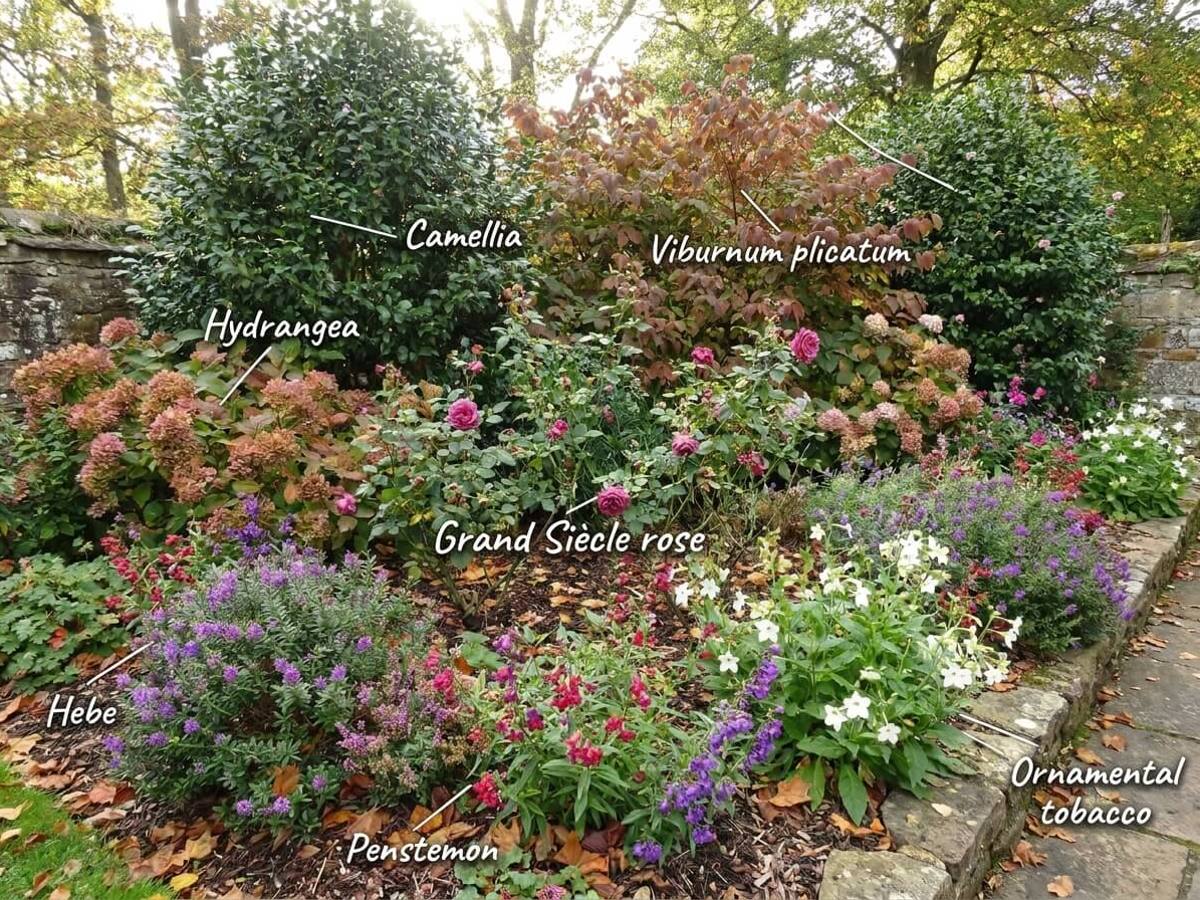
Work on a bed at least 2 m deep. Put one Camellia and one Viburnum plicatum along the back, 1.5 m apart, so each has room to show its shape. Bring the Hydrangea forward of them, roughly 1.2 m from the back shrubs, with the Grand Siècle rose in the brightest gap at the same depth, about 1 m from the Hydrangea. Plant the Hebe in a group of three at 50 cm spacing to make one continuous cushion, then set the Penstemon in two drifts of five at 40 cm, one either side of the Hebe group. Edge the whole front with Ornamental tobacco at 30 cm spacing, planted out after the last frosts and refreshed each year.
In spring the bed is mostly green architecture, with the Viburnum plicatum opening its tiers and the Camellia glossy behind. Summer brings the first flush of the Grand Siècle rose, the Hydrangea heads at full colour and the Penstemon starting its long run. Autumn is the peak: Viburnum plicatum leaves turning plum, Hydrangea heads fading to parchment, Hebe and Penstemon still in flower, Ornamental tobacco at the front and the Camellia opening its first blooms. Through winter the evergreen Camellia and Hebe hold the shape, the dried Hydrangea heads are worth leaving on, and the bare tiered branches of the Viburnum plicatum do the rest.