A bed that sits in the shadow of a house wall or under high tree canopy stays cool and dim for much of the day, and the soil beneath it is often dry in summer and slow to warm in spring. The difficulty is that the brightest months pass by before the leaf canopy fills in, so anything planted here has to do its best work early and then hold its shape quietly for the rest of the year. A good scheme stacks the spring flowering from the back of the bed forwards, then leans on foliage, shape and evergreen structure once the blooms are over.
From back to front: Rhododendron, Camellia, Mahonia, Azalea japonica, Hosta, Bluebells.
At the back of the bed, Rhododendron gives you the height and the solid evergreen mass that stops the planting from looking thin against a wall or fence. Its flower trusses open in mid to late spring in pinks, mauves and whites, held well above eye level in a mature specimen. The leathery, dark leaves make a calm backdrop for everything in front, and because it enjoys the same cool, acidic, humus-rich soil as the rest of this bed, it sets the tone for the whole scheme.
Set slightly forward of the tallest planting, Camellia opens its flowers earlier, often while the garden is still bare, and carries the display from late winter into spring. The blooms are formal and rounded, which plays nicely against the looser trusses behind them. Glossy evergreen leaves keep the middle of the bed furnished all year, and the plant appreciates shelter from early morning sun, which this shaded position provides.
Mahonia brings the one colour the rest of this bed lacks: acid yellow, carried in upright sprays that can last right through to April. The spiny, architectural foliage is a complete contrast to the smooth, rounded leaves either side of it, so it breaks up what could otherwise be a wall of similar greens. Use it at one end of the middle layer rather than in the centre, so its strong outline reads as a deliberate accent.
Dropping down to knee height, Azalea japonica forms low, dense, spreading mounds that smother themselves in flower in spring. The small leaves and compact habit make it the natural step between the tall evergreen shrubs and the perennials at the front. Plant it in a drift rather than as single specimens, so the spring colour reads as a continuous band across the bed.
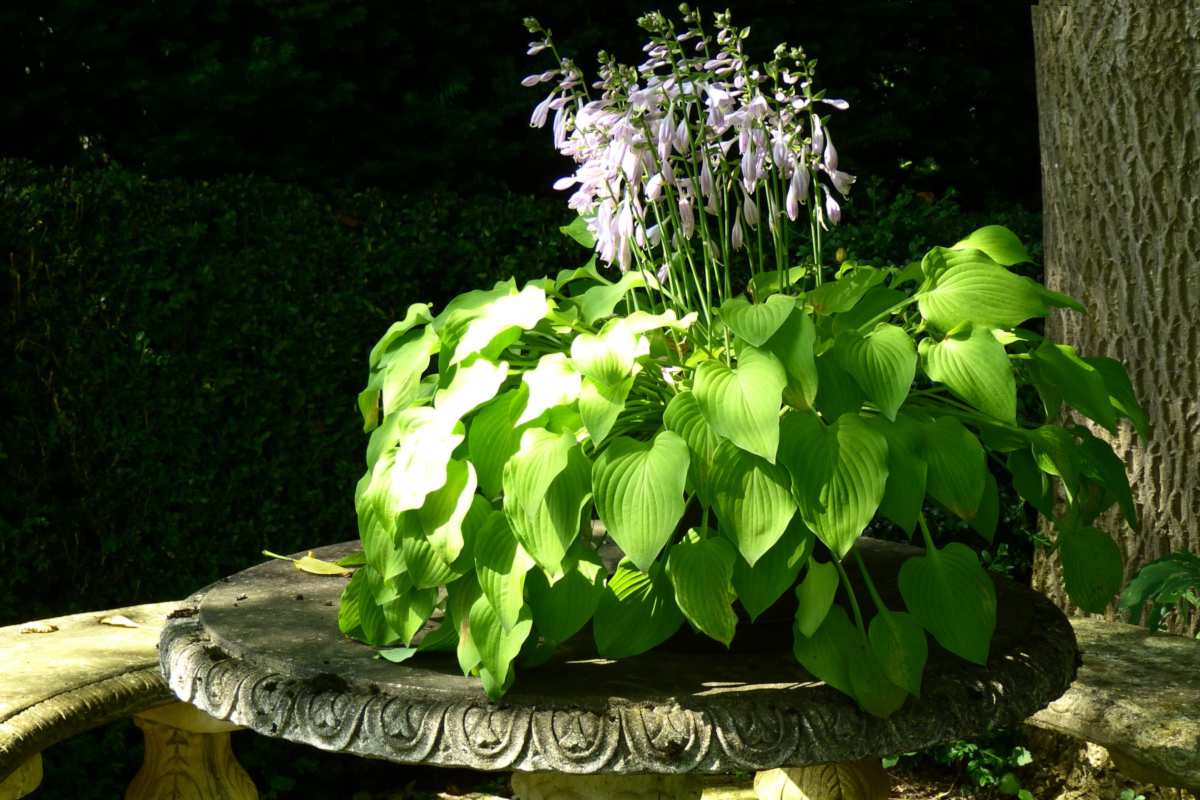
Hosta takes over once the shrub flowers fade, unfurling broad, ribbed, sculptural leaves in blue-green, mid-green or variegated cream. In deep shade the colours stay richer and the leaves grow larger, so this is exactly the position it wants. Its horizontal, light-catching foliage is the perfect foil for the fine twiggy growth above it, and it hides the bare lower stems of the shrubs behind.
Right at the front and threaded between the clumps behind, Bluebells deliver a low haze of violet-blue in mid spring, at ground level, where the bed would otherwise be empty. They flower and set seed before the canopy closes over, then die back discreetly in early summer. Plant them where emerging foliage will later cover the gap they leave, and they will bulk up year on year without any attention.
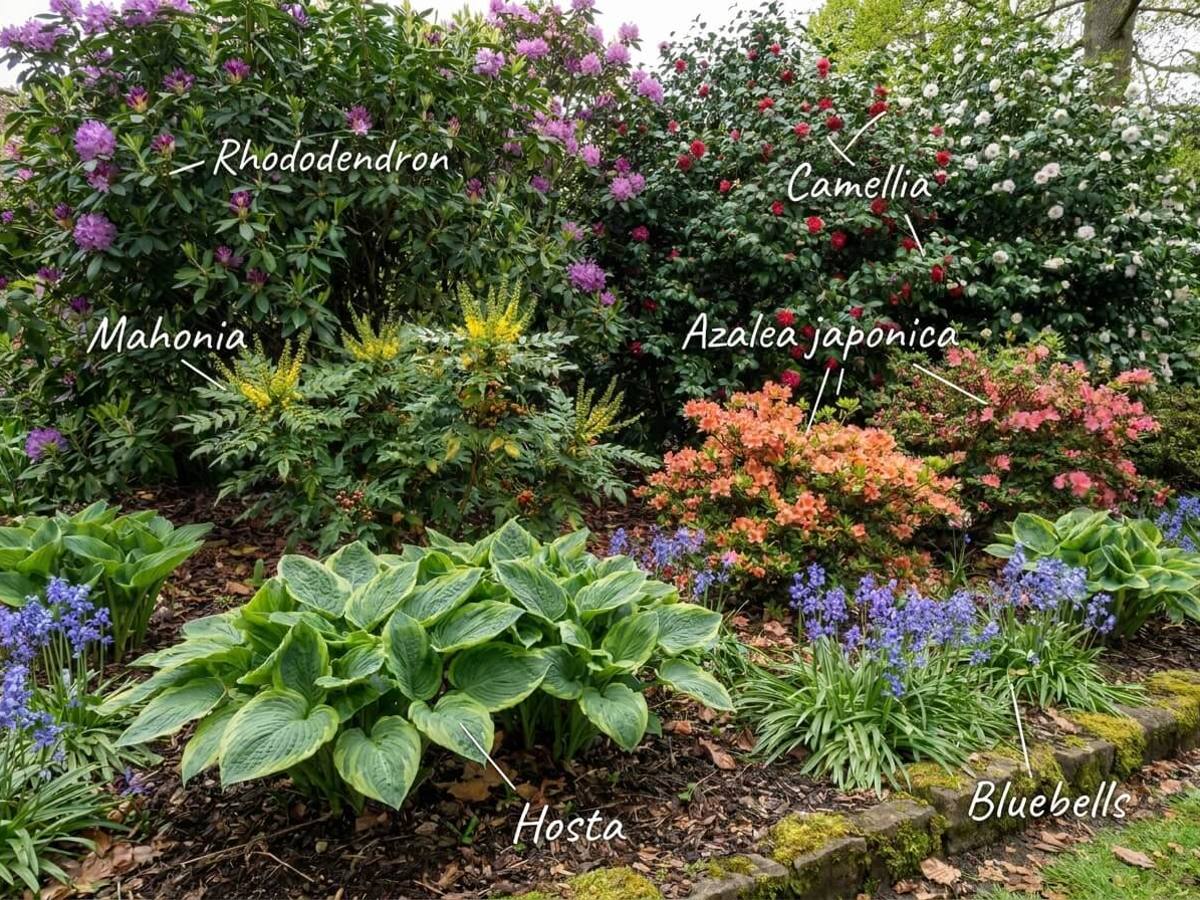
Work in three bands. Set Rhododendron along the back, allowing around 1.5 m between plants and at least 1 m clear of any wall so air can circulate. Bring Camellia forward into the second rank, roughly 1.2 m apart, with Mahonia placed as a single plant at one end of that same band for contrast. In front of them, run a drift of five to seven Azalea japonica spaced about 60 cm apart, curving the group rather than lining it up. Along the front edge, plant Hosta in groups of three at 50 cm spacing, leaving pockets between and around them for Bluebells, which you can drop in at 10 cm apart in loose handfuls of twenty or more bulbs in autumn.
From late winter, Camellia opens first and Mahonia is already in full yellow, so the bed has colour long before most borders wake up. Mid spring is the peak: Bluebells wash the front in blue, Azalea japonica blazes across the middle, and Rhododendron tops it off from the back. By early summer the flowers are gone and Hosta takes charge, spreading broad leaves over the space the Bluebells have vacated. Through autumn and winter the bed falls back on structure alone — three layers of evergreen leaf, glossy and leathery above, spiny and angular at one end — which is enough to keep a shaded corner looking furnished until the cycle begins again.