A border edging in partial shade sits in that awkward strip where the sun reaches for only a few hours a day, usually in the morning or in dappled patches under a wall, a fence or the skirts of a tree. The soil tends to be dry near the roots above and damp further out, and anything planted there has to look presentable from a path at close range, all year round. A good scheme leans on evergreen structure at the back, a wave of spring bulbs and low flowers through the middle, and a soft, spreading front edge that hides bare stems and spent foliage once the display fades.
From back to front: Boxwood, Narcissus, Alumroot, Lady’s mantle, Perennial geranium, Forget-me-not, Squill.
Boxwood is the backbone of this edging, giving a dark evergreen line that holds the shape of the border through winter when everything in front has gone. Partial shade suits it well, keeping the leaves deep green rather than bleaching them. Clipped low, it reads as a wall rather than a feature, which is exactly what the spring flowers in front need to show up against.
Narcissus brings the first real height of colour, rising just above the clipped line in early to mid-spring with yellow and white trumpets. It copes happily with shade cast by deciduous branches, since it does most of its growing before the canopy closes. Plant it behind leafy perennials so that the dying foliage, which must be left to yellow naturally, is screened by new growth coming up in front.
Alumroot is the colour anchor of the middle band, with mounded evergreen leaves in bronze, plum, lime or silver-veined green that look good on a grey February afternoon. It is one of the few plants here that genuinely prefers not to be baked, so the shaded edge suits it. Its ruffled, low dome contrasts well with the rigid clipped Boxwood behind and the flatter leaves on either side.
Lady’s mantle provides the soft, pleated foliage that pulls this scheme together, catching rain in beads along the leaf edges. It greens up early in spring, which makes it the ideal screen for Narcissus leaves as they go over. Later it throws up frothy lime-green flower sprays that soften the hard line of the path.
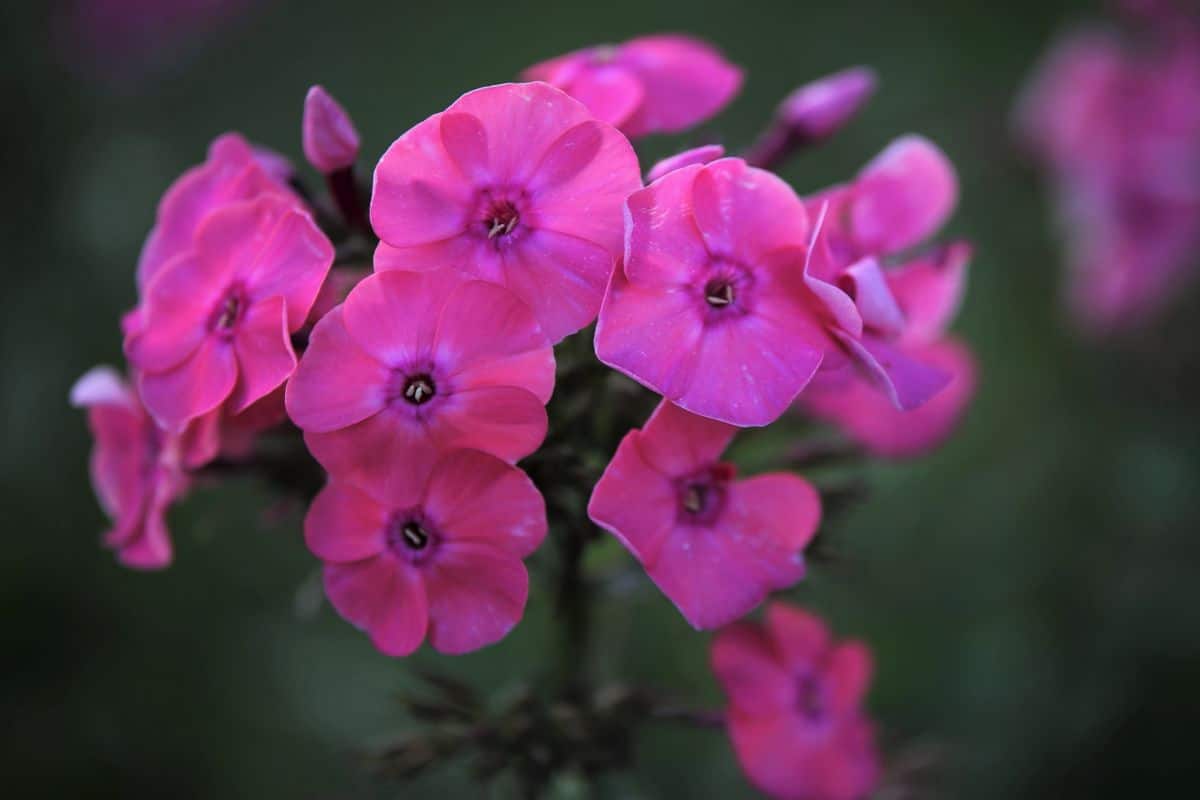
Perennial geranium is the workhorse of a shaded edge, spreading into low cushions of deeply cut leaves topped with pink, mauve or violet flowers from late spring onward. It knits the gaps between clumps so the border never looks like a row of separate dots. Cut it back hard after its first flush and it refreshes with new leaves that carry the edging into autumn.
Forget-me-not supplies the haze of pale blue that makes spring bulbs look twice as good, and it thrives in exactly the cool, part-shaded conditions this border offers. It self-seeds gently, drifting between the other plants year after year without ever becoming a problem. Pull it out once it browns in early summer and the Perennial geranium will close over the space within weeks.
Squill takes the very front of the edging, flowering in intense blue before most perennials have woken up. Being only a few centimetres tall, it needs to be right at the path’s lip where it can be seen. Its early, short season is covered later by the spreading foliage behind it, so the front edge never looks empty.
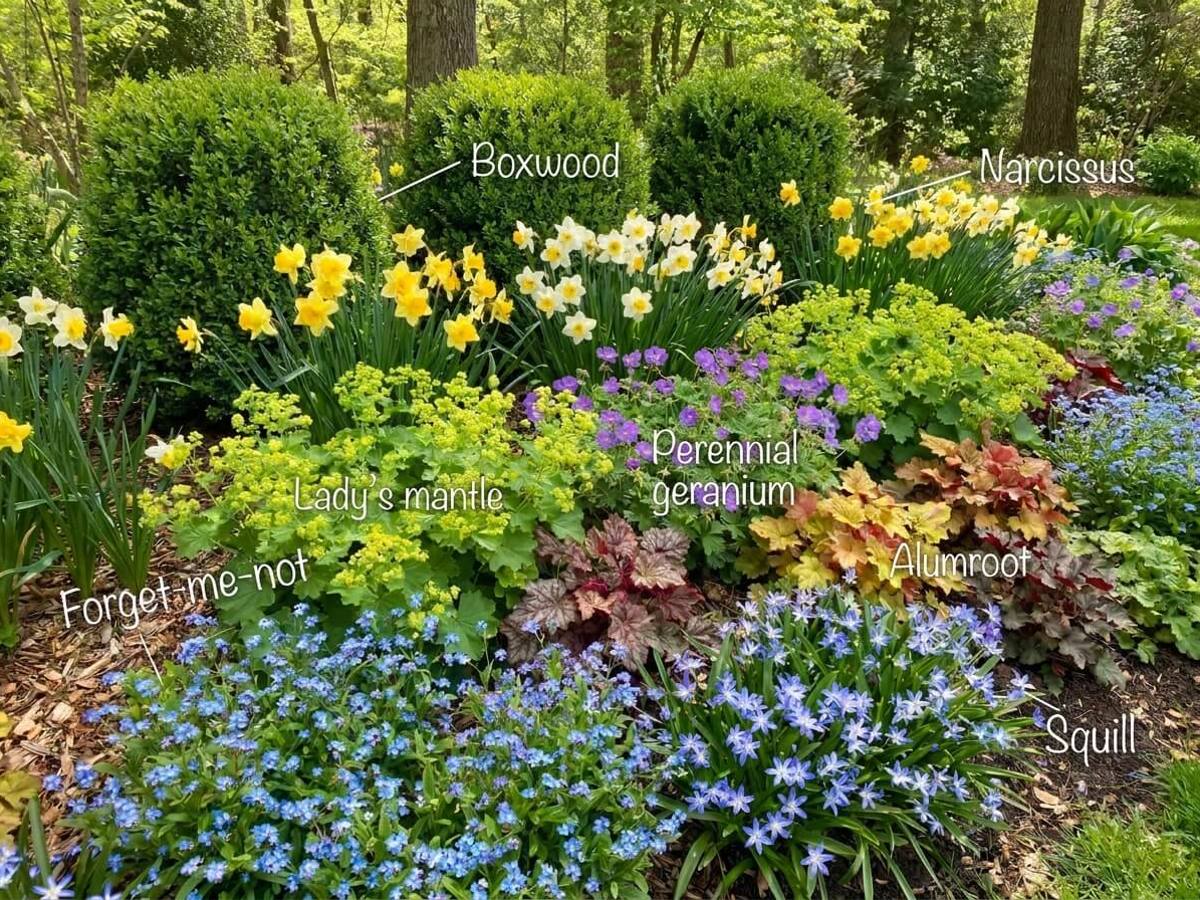
Run the Boxwood along the back of the strip as a single line, spacing plants 25 to 30 cm apart so they knit into a continuous low hedge within two or three seasons. Immediately in front, plant Narcissus in groups of five to seven bulbs, about 10 cm apart within each group, leaving 40 to 50 cm of clear space between groups for the perennials. Set Alumroot and Lady’s mantle alternately in that middle band at roughly 40 cm apart, placing a Lady’s mantle directly in front of each Narcissus group so the dying leaves are hidden. Fill the front third with Perennial geranium at 40 cm spacing, drop Forget-me-not plants into the gaps between them, and scatter Squill bulbs in loose drifts of fifteen to twenty along the final 15 cm closest to the path, planted about 5 cm deep.
From late winter the Squill opens first, blue at ground level against the dark Boxwood line, followed within weeks by Narcissus and then a rising mist of Forget-me-not. Late spring belongs to Perennial geranium and the lime froth of Lady’s mantle, which carry the border through early summer while the bulb foliage retreats unseen. By midsummer the scheme reads as texture rather than flower: pleated, cut and ruffled leaves in layers, with Alumroot holding its colour. Through autumn and winter nothing is in bloom, and the edging rests on the clipped evergreen line at the back and the evergreen Alumroot mounds in front of it, which is enough to keep the border looking deliberate until the first Squill appears again.