A sun-baked wall or pergola post is one of the hottest, driest places in the garden: the masonry throws back heat all afternoon, rain shadows the soil at the foot, and roots compete in a narrow strip of ground. By late summer many climbers have shot their bolt and the whole face turns green and dull just as the garden needs lifting. A good autumn scheme stacks plants that keep flowering into October, uses heat-tolerant stems that cope with reflected warmth, and covers the bare lower metre where climbers always go leggy.
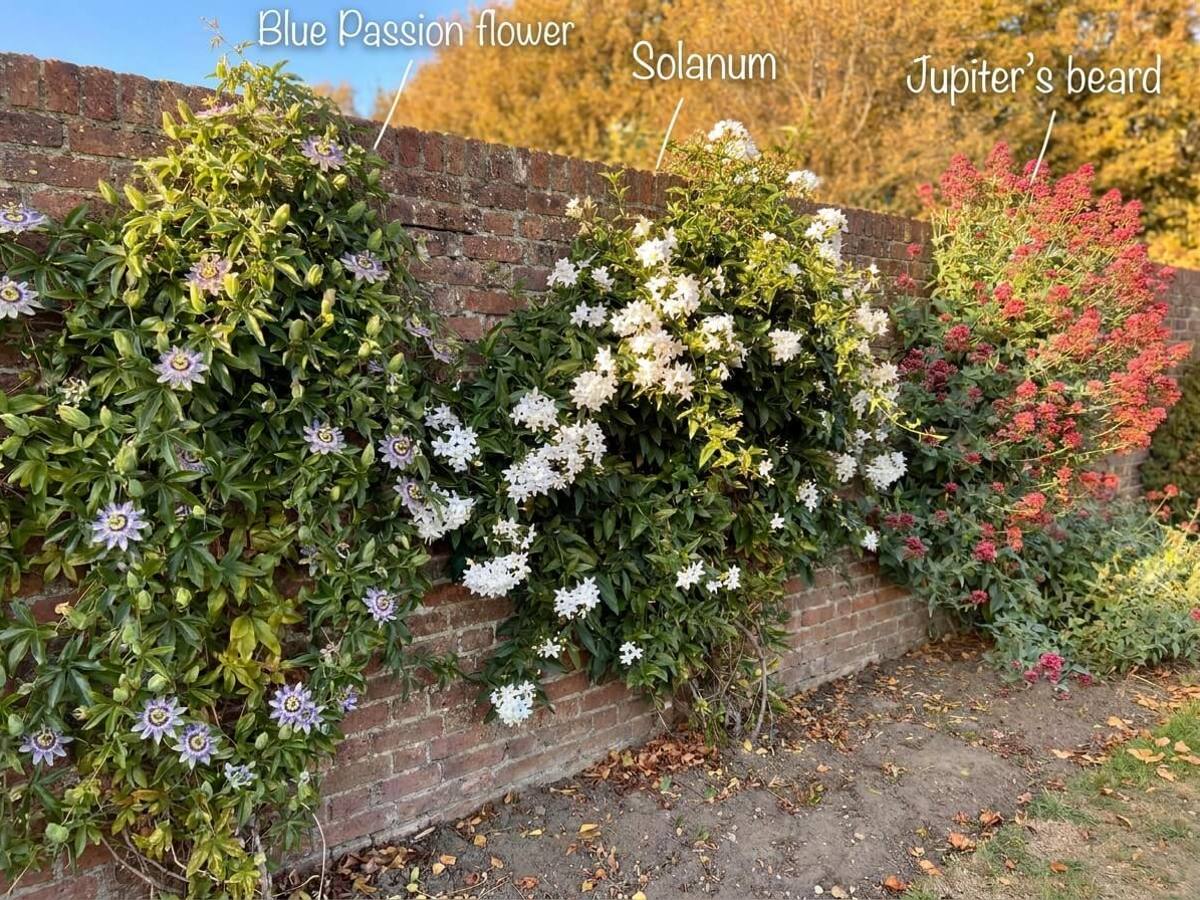
Up the support, from the top down: Blue Passion flower, Solanum, Jupiter’s beard.
Three plants is the limit here, and two would do just as well. They share one surface, one root run and exactly the same light, so a fourth would simply scramble over the others, shade out the lower growth and leave you untangling stems every autumn instead of enjoying the flowers.
Blue Passion flower takes the top of the support and holds it. The tendrils climb fast to the head of a pergola or the top of a 3 metre wall, and the intricate blue-and-white flowers keep coming from midsummer right through to the first proper cold, often followed by orange egg-shaped fruit that carry the display on after the last bloom.
Its leaves are deeply lobed and fairly open, so light still filters down to whatever grows below it. Give it the hottest, highest section and let it do the heavy covering; the other two are there to furnish what it leaves bare.
Solanum fills the middle band with clouds of small starry flowers, pale or purple-tinged depending on the variety you buy, and it flowers tirelessly from late spring until the autumn frosts stop it. That long season is what matters here: when the passion flower above pauses between flushes, the solanum is still studded with bloom.
Its growth is twiggy and flexible rather than dense and heavy, so it weaves through the lower framework without strangling its neighbour. Keep it to one side or to the lower two-thirds of the support and it will stay a partner rather than a bully.
Jupiter’s beard solves the bare ankles. It thrives in exactly the dry, stony, reflected-heat conditions at the base of a sunny wall, throwing up domes of soft grey-green foliage topped with dense heads of pink or crimson flowers from late spring, then repeating into autumn if you cut it back after the first flush.
It is not a climber and never competes for the wall itself, only for the soil, and it asks very little of that. Planted along the foot, it hides the woody lower stems of both climbers and gives the whole scheme a solid, flowering base at eye level and below.
Allow about 3 metres of wall or one full pergola side for the Blue Passion flower, planted 30 to 40 cm out from the base so it escapes the dry rain shadow, with its tendrils guided onto horizontal wires fixed every 40 cm or onto a trellis panel. Give the Solanum around 2 metres alongside it, tying the main stems in loosely with soft twine and never letting it cross into the passion flower’s wires. Plant the Jupiter’s beard in a row at the foot, roughly 45 cm apart, three or four plants per 2 metres of wall. In late winter or very early spring, shorten the passion flower’s side shoots back to within a few buds of the main framework and thin out any tangle of dead stems; tidy the solanum at the same time, cutting back whatever has grown beyond its allotted 2 metres. Shear the Jupiter’s beard hard after its first flush in early summer to trigger the autumn repeat, and cut the clumps down in late winter.
In spring the Jupiter’s beard opens first, while the two climbers are still greening up and being tied in. Early summer brings the Solanum into full flower, and the Blue Passion flower joins it as the heat builds, so from July onward the whole face is covered top to bottom. Autumn is the pay-off: passion flower blooms among ripening orange fruit, solanum still starring the middle, and a second wave of Jupiter’s beard at the base. Through winter the scheme rests, with the bare framework of climber stems on the wires and nothing in flower until the days lengthen again; this is the moment to check your ties and wires before growth restarts.