Home » Health » Broad beans: using the beans, pods and flowers, and what tradition credits them with
Broad beans: using the beans, pods and flowers, and what tradition credits them with
·
0
Broad beans (Vicia faba) are the plump seeds of an annual legume that has been sown in kitchen gardens for several millennia. This page is for anyone with a glut of pods on the plot, or a bag of dried beans in the cupboard: which part to use, how to prepare it, what it tastes like, what herbal tradition made of the flowers, and who should be careful.
Broad bean at a glance
Item
Detail
Botanical name
Vicia faba
Family
Fabaceae
Parts used
Fresh shelled seeds, dried seeds, young pods, flowers
Forms of use
Raw in salads, steamed, pan-fried, soups and purées, dried and soaked, flower infusion or decoction
Harvest season
Flowers mid-spring to early summer; fresh pods late spring to midsummer; dried seeds late summer
Taste
Young beans sweet, nutty and grassy; older beans starchy and mealy with a faintly bitter skin
Nutrients
Plant protein, fibre, vitamin C, B group vitamins, potassium, magnesium, iron, sulfur, polyphenols
What it is credited with
Because of its protein and mineral load, broad bean has a long-standing reputation as a nourishing, restorative and strengthening food in country cooking across the Mediterranean and the Middle East.
Naturopathy values the fibre in fresh and dried beans for everyday digestive comfort and regular transit.
Slimming-minded eating plans in naturopathy often include legumes such as broad beans because they give a feeling of fullness without being calorie-dense.
The polyphenols they contain are described as antioxidant compounds, which is the reason herbalists group broad beans with the other coloured pulses.
In traditional herbalism, an infusion or decoction of the dried flowers was taken as a diuretic, drunk to encourage the flow of water and ease general urinary discomfort.
Folk practice in some regions also used the flower water as a simple skin rinse for dull or tired-looking complexions.
How to use it
Fresh beans, straight from the pod
Pick pods while they are still bright green and the beans inside are no bigger than a thumbnail.
Shell them, then eat raw: a pinch of salt, a dash of olive oil, a few drops of lemon juice. Sweet, green, faintly nutty.
A small handful is plenty at one sitting when they are raw.
Pair raw beans with young pecorino, mint, spring onion or fresh peas.
Cooked
Steam shelled beans 4 to 6 minutes for young ones, 8 to 10 minutes for larger ones.
Pan-fry in olive oil with garlic and savory, 5 minutes on a lively heat, and finish with parsley.
Blitz cooked beans with olive oil and lemon for a purée to spread on toast.
Add a couple of handfuls to a soup in the last 10 minutes so they keep their colour.
Once beans are past their youth, slip off the grey skins after cooking: this is what removes the bitterness.
Dried beans
Soak overnight in plenty of cold water, changing the water once if you can.
Drain, cover with fresh unsalted water and simmer until tender, usually 45 minutes to an hour and a half depending on age.
Salt only at the end, otherwise the skins stay tough.
Season generously: cumin, bay, olive oil and lemon all suit their mealy, earthy taste.
Flower infusion, as tradition prepared it
Gather the flowers on a dry morning when they are fully open, and dry them flat in the shade.
Infusion: a teaspoon of dried flowers per cup, boiling water poured over, covered, 10 minutes, then strained. Mild, honeyed, slightly hay-like.
Decoction: the same quantity brought to a simmer for 5 minutes in cold water, then left to stand 10 minutes off the heat.
Traditionally taken as one or two cups across the day, for a short stretch of a few days rather than continuously.
Which part, in which form
Part used
Preparation
What it is used for
Young fresh seeds
Raw, dressed with oil, salt and lemon
A nourishing spring dish; the sweetest, most delicate flavour
Mature fresh seeds
Steamed, fried or puréed, skins slipped off
Everyday cooking, soups and spreads rich in protein and fibre
Dried seeds
Soaked overnight, then simmered
Winter stews and mashes; the fibre-rich store-cupboard form
Young pods
Sliced and cooked like green beans while very tender
Stretching an early harvest with no waste
Flowers
Dried, then infused or decocted
The traditional diuretic tea of old herbalism
Frequently Asked Questions
The one thing to remember: eat the young beans raw or barely steamed while they are sweet, cook the older ones and slip off their skins, and leave the flower tea to short, occasional use.
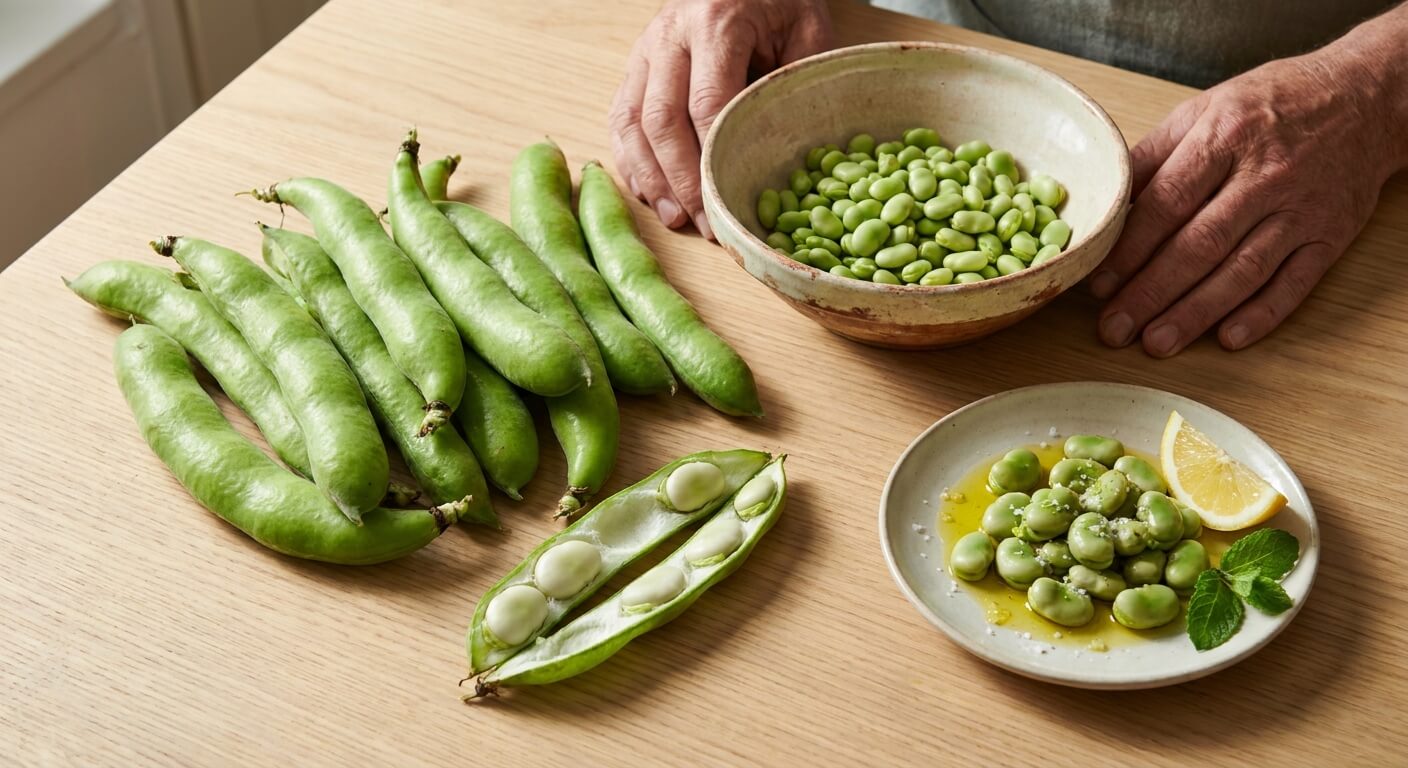
Young shelled beans eaten raw with oil, salt and lemon
Which part of the broad bean is used for a herbal tea?
The dried flowers, gathered mid-spring to early summer and dried flat in the shade. A teaspoon per cup, infused 10 minutes under a lid, gives a mild honeyed drink. In traditional herbalism it was taken as a diuretic, a cup or two a day for a few days at a time.
Do I really have to peel broad beans?
Only when they are past their youth. Very young beans have a tender skin you can eat raw with oil and lemon. Once the beans are large, the grey skin turns tough and slightly bitter, so cook them first and then pinch the skins off, which takes minutes and transforms the taste.
Can anyone eat broad beans raw?
Most people can enjoy a small handful of very young raw beans. But raw beans in large amounts over a long period can trigger favism, a dangerous anaemia, in people who lack the enzyme needed to break down the haemolytic substances in the seeds. If that deficiency runs in your family, avoid broad beans entirely and ask a healthcare professional.
How do I keep a big harvest?
Shell the beans, blanch them for two minutes, cool them in iced water and freeze them in bags. For the store cupboard, leave the last pods on the plant until late summer, dry the seeds thoroughly and keep them in an airtight jar out of the light, then soak them overnight before cooking.
What goes well with broad beans?
Mint, savory, garlic, lemon, olive oil, spring onion and salty sheep’s cheese are the classic partners. In the vegetable patch, sow a few nasturtium or dill seeds nearby to keep aphids moving on, and keep the row well away from beans, tomatoes and bell peppers.
This information is provided for general interest and reflects the traditional use of plants. It is not a substitute for medical advice. If you are on medication, pregnant, or in any doubt, ask a healthcare professional.
Written by Gaspard Lorthiois | Loves helping out, especially when it comes to growing things. Worked in herbal medicine, runs a farm, and dabbles in tech. Master's degree and engineer.