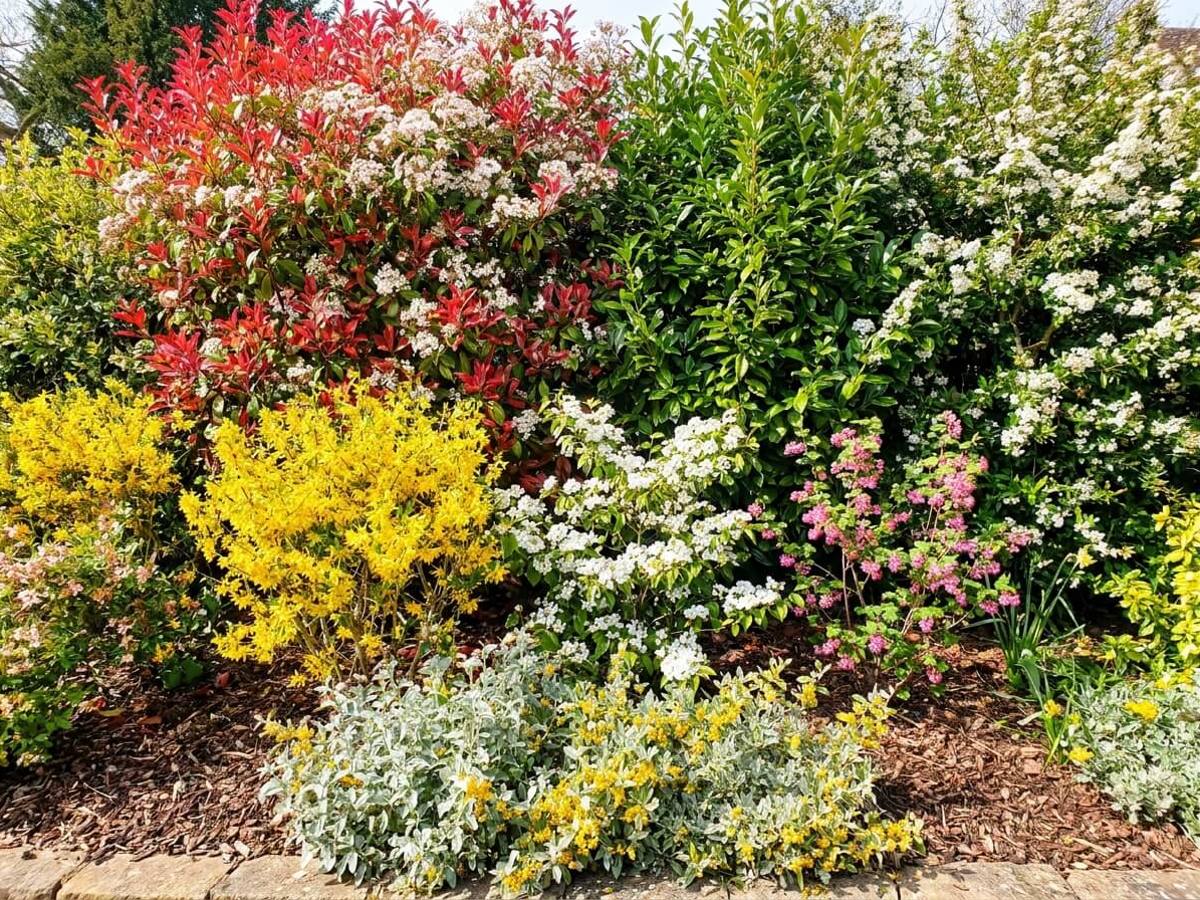
A hedge line in full sun is one of the hardest places in the garden: the soil dries fast along its base, the light is flat and strong from mid-morning onwards, and anything planted there has to look presentable from both sides. The temptation is to run a single species from end to end, which gives you structure but one short moment of interest and nothing else. A better scheme layers evergreen backbone at the back with a tier of spring-flowering shrubs in front, so the hedge holds its shape all year and erupts into colour from March to May.
From back to front: Photinia, Portugal laurel, Firethorn, Forsythia, Watanabe, Flowering currant, Silverberry.
Photinia takes the back of the scheme because it grows tall, dense and upright, and because full sun is exactly what it wants to colour up properly. The new growth flushes bright red in spring, at the same moment the flowering shrubs in front begin, and clusters of small creamy flowers follow. Behind the lower tiers it reads as a warm backdrop rather than a wall, and it tolerates the hard spring clip that keeps a mixed hedge from sprawling forwards.
Portugal laurel gives you the dark, glossy, fine-textured evergreen that stops the hedge looking thin in February. Its leaves are smaller and neater than most broadleaf evergreens, with reddish leaf stalks that pick up the new growth on Photinia behind it. Set as an occasional block rather than a continuous run, it acts as a visual full stop between the louder flowering shrubs and keeps the whole line solid in winter.
Firethorn earns its place twice over: dense white flower clusters in late spring, then berries that hold through autumn and into winter. It is thorny and tightly branched, so it fills the middle depth of the hedge and makes it genuinely impenetrable where you need that. It enjoys the heat and dryness of a sunny line and will not sulk where the soil bakes.
Forsythia is the earliest loud note in the scheme, throwing out bare yellow stems before most of the hedge has woken up. In full sun it flowers heavily and evenly rather than only on the top third. Once the flowers drop it becomes a plain green mass, which is precisely why it belongs in the middle of the line with evergreens either side to carry it through the rest of the year.
Watanabe brings a horizontal, tiered branching habit that breaks up the vertical grain of everything behind it. Flat white flowerheads sit along the branches in late spring, just as Forsythia finishes, so the yellow and white never clash. It stays lower and more open than its neighbours, which makes it a natural step down from the tall back tier.
Flowering currant supplies the pink that softens the yellow and white elsewhere in the scheme, hanging in drooping clusters through April. Its foliage is soft, lobed and matt, a useful contrast to all the glossy evergreen leaves behind it. It is quick to establish and forgiving of a sunny, free-draining spot, and it responds well to being cut back after flowering to keep it inside its allotted depth.
Silverberry goes at the very front, where its pale, metallic foliage catches strong sunlight and lifts the base of the hedge out of shadow. It stays evergreen, copes with drought and wind better than anything else in the scheme, and holds the front edge tidy through winter when the deciduous shrubs are bare twigs. The silver tone cools down the pinks and yellows in spring and sits comfortably against the dark green of Portugal laurel.
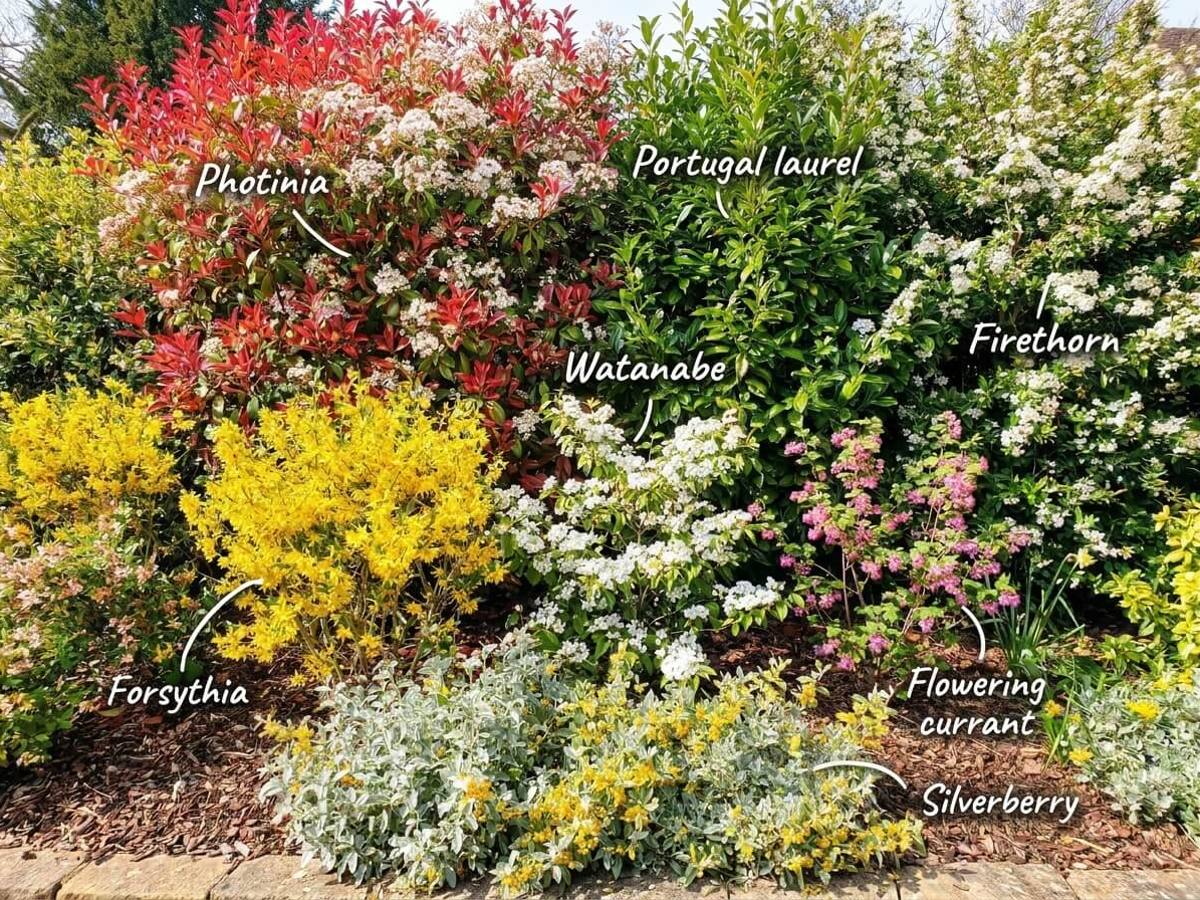
Work in a band roughly 1.5 to 2 m deep. Run the back row first: Photinia at 1 m apart along the main length, with two or three groups of three Portugal laurel dropped in at intervals to anchor the line. In the middle tier, space Firethorn at 80 cm where you want security, and place Forsythia and Watanabe in groups of three at 1 m apart rather than singly, so each reads as a block of colour. Bring Flowering currant forward in drifts of three at 90 cm, and edge the whole front with Silverberry at 80 cm, staggered slightly so the base knits together within two or three seasons.
In March, Forsythia opens first against bare wood, backed by evergreen. April brings the pink of Flowering currant and the red flush on Photinia, and by May, Watanabe and Firethorn carry white across the whole line. Summer is a quiet, layered green-and-silver hedge with contrasting leaf shapes doing the work. Autumn hands over to Firethorn berries, and through winter the Photinia, Portugal laurel and Silverberry keep the structure dense, pale at the front and dark behind, so the hedge never reads as empty.