A patio or balcony in full sun is a bright, exposed place in winter: the light is low and raking, the wind dries pots far faster than you would expect, and the ground around you is bare for months. Anything you grow here has to cope with sun all day, cold nights and compost that swings between soaked and bone dry. A good scheme stacks evergreen structure at the back, scent in the middle and low, generous colour at the front, so there is something to look at from the doorway and something to smell as you walk past.
Pot by pot, tallest first: Viburnum tinus Lisarose, Lonicera purpusii, Kumquat, Winter heather, White Pearl hyacinth, Pansy.
This is the backbone of the group and the tallest thing in it, a dense evergreen that holds its shape through the worst of the weather. Viburnum tinus Lisarose opens pink-budded, white-flushed clusters from late autumn right through winter, then carries metallic blue berries afterwards. Stand it where it blocks the worst of the wind, and the smaller pots in front of it will dry out noticeably more slowly.
Where the viburnum gives you bulk, this one gives you scent on cold still days, which is the rarest thing on a winter balcony. Lonicera purpusii drops its leaves and flowers on bare twigs, small creamy flowers that carry a long way in cold air. Place it beside the door or the seat rather than at the back, and let the evergreens either side cover for its leafless winter silhouette.
A full-sun patio is one of the few places a citrus is genuinely happy, and this one earns its space with glossy evergreen leaves and small oval fruit that ripen orange over winter. Kumquat brings the only strong warm colour in the scheme, which lifts the whites and pinks around it. It is the one plant here that will need shelter or moving indoors in a hard frost, so keep its pot light enough to shift.
This is the mid-height filler that stops the big pots looking like separate objects. Winter heather flowers for weeks on end in pink, mauve and white spikes, with fine needle foliage that reads as texture rather than as a shape. Group two or three pots of it at the feet of the taller shrubs and the whole arrangement knits together.
Forced bulbs give you a short, concentrated burst of white and perfume at the darkest point of the year. White Pearl hyacinth picks up the white in the viburnum flowers and doubles the scent already coming from the honeysuckle pot. Plant it in its own container so it can be moved to the front while in flower and tucked behind once the spikes go over.
The front row, and the part that does the most work for the least money. Pansy flowers through mild winter spells and then properly from late winter onward, and you can match it to the scheme by choosing white and deep purple rather than the full mixed range. It spills over pot rims, softens hard edges and hides the bare compost in the bulb pot.
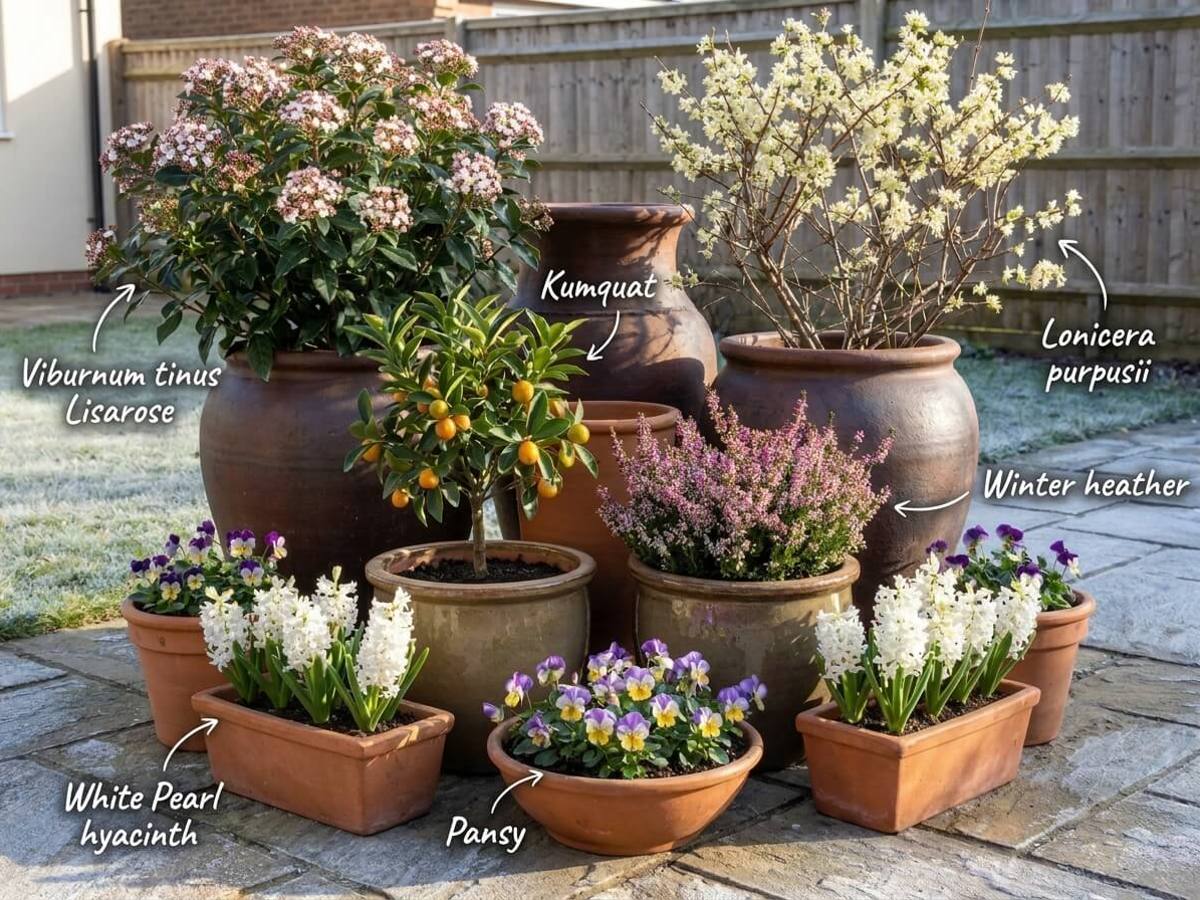
Give Viburnum tinus Lisarose a 50 cm pot of its own and stand it at the back corner, where it shelters everything else. Lonicera purpusii needs a 45 cm pot, placed at the end of the group nearest the door; Kumquat takes a 40 cm pot with free-draining citrus compost, set in the sunniest spot. Winter heather goes into two or three 25 to 30 cm pots at the base of the shrubs, and Pansy can share those pots around the edge or fill its own 20 cm bowls at the very front. White Pearl hyacinth is best alone in a 20 to 25 cm pot so it can be moved. Water the two big shrubs once a week in winter and two or three times a week in summer heat; Kumquat needs checking every few days all year, never letting the compost dry out completely; heather, pansy and hyacinth pots are small and should be checked twice a week in winter and daily in summer.
From late autumn the viburnum starts opening and the kumquat fruit colours up, with heather coming into flower beneath. Midwinter is the peak: scent from Lonicera purpusii and White Pearl hyacinth, white and pink flower, orange fruit and three different evergreens holding the shape. By late spring the hyacinth has gone over and the honeysuckle has leafed out, leaving pansy to carry the colour, and through summer the group is deliberately quiet — glossy citrus leaves, dense viburnum, blue berries — which is exactly the rest it needs before the whole cycle starts again.